

EUR.1 and Preferential Origin: REX and Statements on Origin Explained
How preferential origin works, when you need an EUR.1 movement certificate, when a statement on origin from a REX registered exporter is enough, and what to keep on file.
6 min read
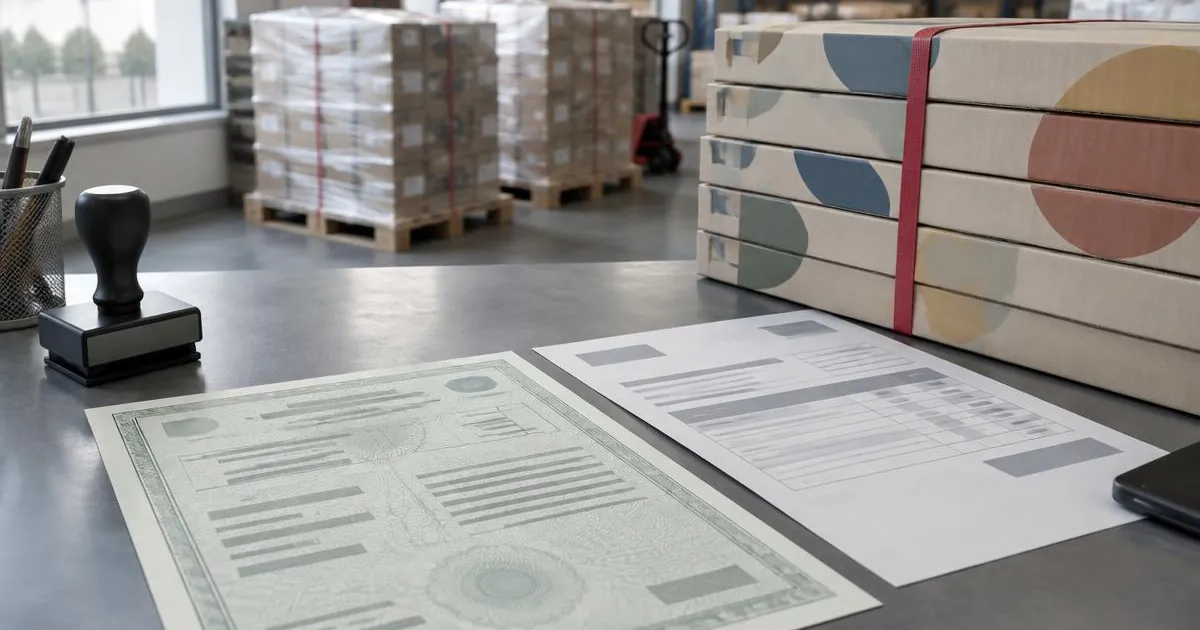
An EUR.1 is a movement certificate, endorsed by customs, that proves goods have preferential origin under an EU trade agreement, so the buyer abroad pays reduced or zero import duty. Many newer agreements replace the EUR.1 with a statement on origin made by the exporter, often linked to a REX registration. Which proof you need depends on the agreement and the value of the shipment.
This article is general information, not legal or customs advice.
What is preferential origin?
Preferential origin decides whether goods qualify for the lower tariff in a trade agreement or a unilateral scheme such as the EU's GSP. The European Commission's page on preferential rules of origin explains that a product must meet the conditions in the relevant origin protocol to enter at reduced or zero duty. Goods that meet them are called originating goods.
This is different from the "made in" label on the product. Preferential origin is a legal status tied to one specific agreement, so the same carton can be originating for one destination and not for another.
Wholly obtained or sufficiently processed
There are two ways for goods to qualify. Wholly obtained goods are made entirely from materials grown or produced in the EU or the partner country, with no imported non-originating elements. Everything else must be sufficiently worked or processed according to product-specific list rules. The Commission describes three kinds of list rule:
- a value limit on non-originating materials;
- a change of tariff heading between the materials and the finished product;
- a specific processing operation that must take place.
The list rules follow the tariff classification, so you need the right HS code before you can check them. Some rules also allow a tolerance for a small share of non-originating material.
Cumulation
Cumulation lets you count materials from a partner country as if they were your own. The Commission lists bilateral, diagonal, regional and full cumulation, and notes that it only works between countries that apply identical origin rules. For a printer, this can mean that board bought in Switzerland still counts when the finished boxes go to Norway.
EUR.1 movement certificate: when you still need one
The Commission's page on proof of origin lists the EUR.1 and EUR-MED movement certificates as government certificates used under certain EU agreements. The paper form must have a printed green guilloche background. In practice, the EUR.1 is still common in trade with Switzerland, Norway and other partners in the Pan-Euro-Mediterranean (PEM) area.
The Luxembourg government portal describes the process for an EUR.1 movement certificate: the exporter fills in the form, states whether the goods are wholly obtained or which processing gave them EU origin, and has it endorsed by the customs office when the goods are ready for export.
Invoice declaration instead of an EUR.1
For smaller shipments you can often skip the EUR.1. According to the same Luxembourg page, any exporter can use an invoice declaration for goods worth up to EUR 6,000, and an approved exporter can use one whatever the value. Approved exporter status is applied for at your national customs authority. If you ship regularly to PEM countries, it usually saves time on every consignment.
What changed with the revised PEM rules
The revised PEM Convention entered into force on 1 January 2025. The Commission's page on Pan-Euro-Mediterranean cumulation and the PEM Convention says the new rules bring more flexible product rules, duty drawback for most products and a higher tolerance for non-originating materials. Old and new rules ran in parallel during 2025. The Swiss customs authority confirms that for Switzerland and the EU, only the revised rules apply from 1 January 2026. The Commission also notes that Switzerland has issued electronic EUR.1 certificates since 16 March 2026.
Statement on origin and the REX system
Most newer EU agreements use self-certification instead of an EUR.1. The exporter writes a statement on origin on the invoice or another commercial document. The REX system page on Access2Markets explains that exporters register with the authorities in their own country to become registered exporters, and that the wording of the statement is set out in Annex 22-07 of Implementing Regulation (EU) 2015/2447. Registrations are published, so a buyer can check whether an exporter's REX number is valid.
Do you need a REX number?
For consignments up to EUR 6,000 (ex-works value), an unregistered exporter can make a statement on origin, while above that amount you need to be registered. Finnish Customs lists the arrangements where its exporters need a REX number for proofs of origin over EUR 6,000, including Japan, the United Kingdom, Vietnam, Singapore, New Zealand and Chile, as well as Canada, where the proof is called a declaration of origin.
Importer's knowledge
Under the EU agreements with Japan, New Zealand and the United Kingdom, the importer can also claim the preference based on its own knowledge, according to the Commission. In that case the buyer needs enough information from you to support the claim, so be ready to answer questions about materials and processing. For UK trade in general, see our guide on selling to UK businesses after Brexit.
Supplier's declarations: proving origin of what you buy
An exporter can only certify origin if it knows the origin of its inputs, which is what supplier's declarations are for. A supplier states the preferential origin of goods it delivers, and the customer uses that information when it exports.
For regular deliveries, a long-term supplier's declaration covers all shipments of the named products over a period. The Austrian Economic Chambers' template for a long-term supplier's declaration follows Annex 22-16 of Regulation (EU) 2015/2447 and notes that the period may not exceed 24 months. The supplier must tell the customer promptly if the declaration stops being valid.
EUR.1 or statement on origin: a quick checklist
- Check the agreement: look up the destination and the product on Access2Markets to see which proof applies.
- Check the rule: confirm the HS code and the list rule, and calculate the non-originating content if the rule is value-based.
- Collect evidence: get supplier's declarations for key materials.
- Pick the proof: EUR.1 or invoice declaration in PEM trade, statement on origin with a REX number where the agreement uses REX.
- Keep records: the Commission says exporters must keep proofs of origin and supporting documents for at least three years.
Get it wrong and the cost lands on your customer: if goods turn out not to qualify, customs can refuse the preference and recover the unpaid duty.
Asking about preferential origin in a request for quotation
If you buy packaging or print from a supplier outside your own customs territory, or resell goods abroad, ask about origin before you order. A supplier that can issue an EUR.1 or a statement on origin can make a real difference to your landed cost.
On Flobid you can add this to the description when you request quotes for shipping boxes or any other category: ask suppliers to state the HS code, the preferential origin and the proof they can provide. If you are exporting to the EFTA countries, our guide to exporting to Norway and Switzerland covers the rest of the paperwork.
Sources
- Preferential rules of origin, European Commission, Taxation and Customs Union
- Proof of origin, European Commission, Taxation and Customs Union
- EUR.1 Movement Certificate / Invoice declaration, Guichet.lu, Luxembourg government
- The Pan-Euro-Mediterranean cumulation and the PEM Convention, European Commission, Taxation and Customs Union
- Rules of origin of the revised PEM Convention, Federal Office for Customs and Border Security (FOCBS), Switzerland
- REX system, European Commission, Access2Markets
- Registered exporter (REX), Finnish Customs
- Long-term supplier's declaration for products having preferential origin status, WKO, Austrian Economic Chambers
Frequently asked questions
What is an EUR.1 certificate?
An EUR.1 is a movement certificate endorsed by customs that proves goods have preferential origin under an EU trade agreement, so the importer can pay reduced or zero duty.
When can I use an invoice declaration instead of an EUR.1?
Under the agreements that use the EUR.1, any exporter can usually make an invoice declaration for goods worth up to EUR 6,000, and approved exporters can use one for any value.
Do I need a REX number to make a statement on origin?
Only above EUR 6,000 per consignment (ex-works value). Below that, an unregistered exporter can make a statement on origin under the agreements that use REX.
How long is a long-term supplier's declaration valid?
The period stated on a long-term supplier's declaration may not exceed 24 months.