

Roll-Up Banner Size Guide: Standard Formats and What to Ask Your Printer
The standard roll-up banner sizes, why the visible area is smaller than the print, which materials and bases to choose, and how to get comparable quotes.
5 min read
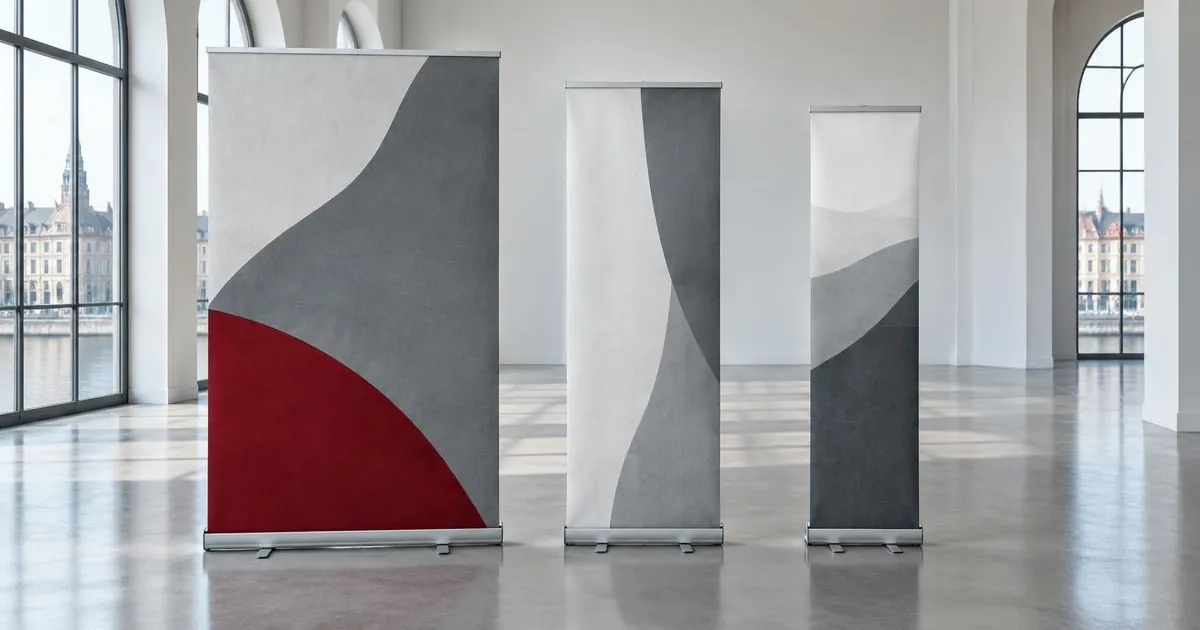
Choosing the right roll-up banner size depends on the space, the viewing distance and how often the display travels. A roll-up, also called a pull-up banner, is a printed graphic that rolls into an aluminium base and is held up by a pole, which makes it the quickest display to set up at trade fairs, receptions and events.
This guide lists the standard formats, explains why the visible area is smaller than the print, and shows what to ask printers so their quotes can be compared.
Standard roll-up banner sizes
Most European printers offer a similar range of roll-up banner sizes. The widths change; the height of most standard models is around two metres.
| Width x height | Typical use |
|---|---|
| 60 x 200 cm | Narrow spaces, counters, corridors |
| 85 x 200 cm | The most common format, easy to carry |
| 100 x 200 cm | More room for text and images |
| 120 x 200 cm | Larger walls and stand backgrounds |
| 150 x 200 cm | When one roll-up has to do the work of two |
| 200 x 200 cm and larger | Back walls and stage backdrops |
These formats appear across printers' ranges, and one online printer lists 85 x 200, 100 x 200 and 120 x 200 cm plus a 200 x 300 cm version and A4 and A3 table models, while another offers 60, 85, 100 and 150 cm widths at 200 cm high, and a 200 x 200 cm square.
Which roll-up banner size should you choose?
- 85 cm wide if the roll-up travels often, stands next to a counter or is one of several on a stand.
- 100 to 120 cm wide if it is the main message on a small stand or in a reception.
- 150 cm and wider if it replaces a back wall. Check the weight and the bag, because wide models are heavier to carry.
- Table models for desks and counters, where a full-height stand would block the view.
If you plan to stand several roll-ups side by side, choose one roll-up banner size for all of them so the tops line up and the graphics can run across.
Roll-up banner size vs visible area
Whatever roll-up banner size you pick, the printed graphic is larger than what people see. Part of it sits inside the cassette at the bottom and under the top rail, so keep logos and text away from the edges.
Safe zones and bleed
Every stand is different, which is why printers give templates. As an example, one printer's template for an 85 x 200 cm model uses a file size of 856 x 2066 mm including 3 mm bleed and asks for important content to stay at least 60 mm from the bottom, 10 mm from the top and 4 mm from the sides. Another asks for a PDF in the correct size, CMYK colour and 15 mm margins at top and bottom.
The lesson is simple: ask for the template of the exact model you order, and do not reuse a file made for another printer's stand without checking the measurements.
Designing for your roll-up banner size
A roll-up is read from a few metres away, often in a busy hall, so the layout matters as much as the format. The same design rarely works on every width: a layout made for 85 cm can look empty at 150 cm, and a wide design squeezed onto a narrow stand quickly becomes hard to read.
Layout tips that work at most sizes
- Top third: put the logo and the main message here, where it is visible above tables and people.
- Middle: one image or a short list of products or services, kept simple.
- Lower part: contact details or a web address, but well above the safe zone at the bottom.
- Few words: a headline and three to five short points are usually enough.
- Contrast: dark text on light backgrounds or the reverse, so the message survives hall lighting.
Before you approve the file, print a small scaled-down proof or view it at 10 percent on screen from across the room. If the message is unclear at that size, it will be unclear on the stand as well.
Materials, bases and fire rating
Print material
- PVC film: the classic, affordable choice for high-resolution printing.
- PET and PVC-free films: offered by some printers as an alternative to PVC.
- Polyester fabric: a textile option, available from some printers with an opaque back.
- Blockout: material that blocks light. Cheaper frontlit material lets light shine through, which can show when there is a bright window or spotlight behind the banner.
Base, pole and bag
Printers usually offer several base levels, from light budget stands to heavier premium and luxury models described as more durable. Weigh stability and durability against how far you will carry the stand. Ask whether the graphic can be replaced in the same base, which saves money when the message changes.
Fire-rated materials for trade fairs
Many trade fair venues set fire rules for decorative materials. Messe Frankfurt, for example, states that all decorative materials must comply with class B1 of DIN 4102 and/or class C of EN 13501-1. Check the technical guidelines of your fair and ask the printer for the material's fire classification and certificate.
How to get comparable roll-up banner quotes
Roll-ups look like a simple product, but quotes vary because printers assume different bases, materials and delivery, so put these points in your request:
- Roll-up banner size, single or double-sided, and the number of units.
- Base level (standard or premium) and whether you want a padded bag.
- Print material, blockout and any fire rating you need.
- Whether you supply print-ready files or need design help.
- Delivery address, the date you need the stands and the delivery term.
With the roll-up banner size and these details fixed, every printer quotes the same thing. If you are planning a whole stand, our guide to exhibition stand cost drivers covers the bigger picture.
Order roll-ups through Flobid
On Flobid you can send a request for roll-ups and banner stands to suppliers in that category who deliver to your country, and compare the quotes side by side. The Printing Buyer Resource Pack includes a request template for print jobs, and it is free for buyers.
Sources
- Printed roll-up banners, PrintSimple
- Superior Roll-Up, Pixartprinting
- Roll-up banner 85x200 template, PrintSimple
- Roll-up banner printing?, Printenbind
- Factsheet: Presentations, Messe Frankfurt
Frequently asked questions
What is the standard roll-up banner size?
85 x 200 cm is the format almost every printer lists, and the most common choice. Printers also commonly list 100 x 200 cm, and wider versions such as 120 or 150 x 200 cm.
How much of a roll-up graphic is hidden?
It depends on the stand, and one printer's template, for example, asks for important content to stay at least 60 mm from the bottom edge because that part can disappear into the cassette.
Do roll-ups at trade fairs need to be fire rated?
Many venues require flame-retardant decorative materials, and Messe Frankfurt, for example, requires class B1 of DIN 4102 and/or class C of EN 13501-1, so check the fair's technical guidelines.