
REACH SVHC Rules for Promotional Products: What Buyers Should Ask
What the REACH Candidate List means for branded merchandise, which duties start at 0.1 percent, and the questions to ask suppliers before you order.
5 min read
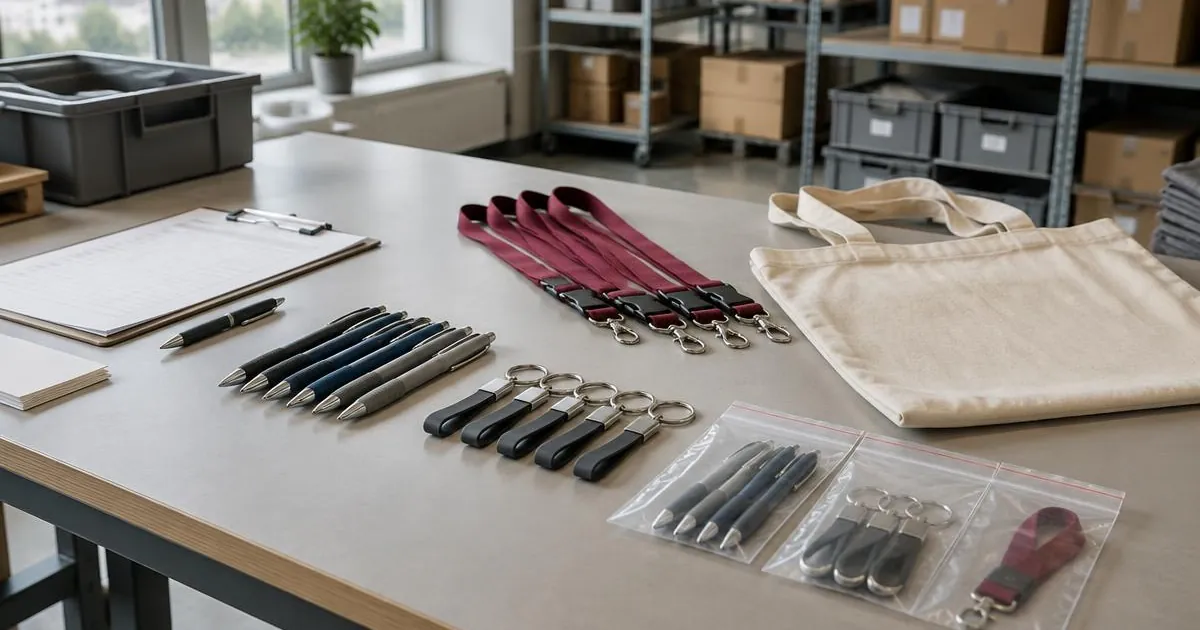
REACH SVHC rules decide what a supplier of promotional products must tell you about hazardous chemicals in the goods you buy. If a pen, lanyard, bag or power bank contains a substance of very high concern (SVHC) above 0.1 percent by weight, the supplier must pass on information so the item can be used safely. This guide explains the rules in plain terms and shows what a purchasing team should ask before ordering branded merchandise.
This article is general information, not legal advice.
What does REACH SVHC mean?
REACH is the EU regulation on chemicals, and within it, substances of very high concern are chemicals that may have serious effects on health or the environment, for example because they are toxic for reproduction. The European Chemicals Agency (ECHA) puts these substances on the Candidate List, and that list is what most people mean when they talk about REACH SVHC.
The list grows over time, and in February 2026 ECHA added n-hexane and bisphenol AF and its salts, which brought the Candidate List to 253 entries, as SGS reported. Each addition creates new duties for companies whose products contain that substance, so a declaration that was correct last year may not be complete today.
Why promotional products are a typical risk area
Branded merchandise is often made from many different materials: plastics, rubber grips, coatings, textiles, metal parts and electronics. Items are frequently sourced from several factories and decorated by another company. That long chain makes it easy for chemical information to get lost, which is why REACH SVHC questions belong in every promotional products request.
Which REACH SVHC duties apply to articles?
A promotional item is an "article" under REACH: an object whose shape and design matter more than its chemical make-up. Three duties follow once a Candidate List substance is present above 0.1 percent weight by weight.
- Information down the supply chain: EU and EEA suppliers of such articles must give their customers enough information to allow safe use (SGS).
- Answers to consumers: if a consumer asks, the supplier must reply within 45 days. The Belgian Federal Public Service for health explains that the consumer has a right to know, and that the 0.1 percent threshold applies to each article separately, not to the whole product.
- Notification to ECHA: EU producers and importers must notify ECHA when an article contains more than 0.1 percent of a listed substance and the total is above one tonne per year. The notification is due within six months of the substance being added to the list.
The SCIP database
There is also a duty under waste law: since 5 January 2021, companies that supply articles containing Candidate List substances on the EU market must submit information to ECHA's SCIP database under the Waste Framework Directive, as ECHA confirmed when the SCIP duty started. For an importer of promotional products this is a real administrative task, so ask your supplier who handles it.
The 0.1 percent threshold per component
Because the threshold applies to each article, a small rubber grip on a pen or the coating on a cable counts on its own. A supplier cannot dilute the figure by calculating it over the full weight of a gift set. When you ask for a REACH SVHC statement, ask that it covers every component, including the printed or engraved parts.
REACH SVHC is not the only chemical rule
The Candidate List is about information, while separate restrictions in Annex XVII of REACH set hard limits that products must meet before they can be sold at all. For promotional products the restriction on polycyclic aromatic hydrocarbons (PAHs) is a good example.
Commission Regulation (EU) No 1272/2013 added entry 50 to Annex XVII. According to the ECHA guideline on the scope of entry 50, rubber or plastic parts that come into contact with the skin or the mouth may not contain more than 1 mg/kg of any of the eight listed PAHs in articles supplied to the general public. For toys and childcare articles the limit is 0.5 mg/kg. The guideline gives examples that are common in merchandise: grips and handles, watch-straps, wrist-bands and drinking bottles.
| Rule | What it does | Typical evidence |
|---|---|---|
| Candidate List (REACH SVHC) | Triggers duties to inform and notify above 0.1 percent | Supplier declaration naming any SVHC per component |
| Annex XVII restriction | Bans or limits a substance in certain products | Test report from an accredited laboratory |
What should buyers ask suppliers about REACH SVHC?
You do not need to become a chemist. You need clear written answers that you can keep on file and show to a customer or an authority. These questions work well in a request for quotation.
- Declaration: Does any component contain a Candidate List substance above 0.1 percent? Please name the substance and the component, and state which version of the list you checked.
- Restrictions: Does the product meet the Annex XVII restrictions that apply to it, such as the PAH limits for grips and straps? Can you share a recent test report that shows this?
- Decoration: Are inks, coatings and adhesives used for branding covered by the same declaration?
- Updates: Will you tell us if a new SVHC is added that affects this product?
- SCIP: If the product contains a listed substance, who submits the SCIP notification?
Red flags in supplier answers
- A generic "REACH compliant" statement with no date and no product name.
- A declaration that refers to an old list version, before the 2026 additions.
- Test reports for a different colour, material or factory than the one quoted.
- No answer to the question about decoration materials.
How REACH SVHC fits with product safety and eco labels
Chemical rules sit next to general product safety rules. A branded water bottle or phone stand given away at an event also has to be safe under the EU product safety framework, which we cover in our guide to GPSR for promotional products. If you plan to use eco claims, note that SGS points out products containing SVHCs cannot receive the EU Ecolabel.
A sensible routine is to collect the SVHC declaration, the relevant test reports and the product safety information in one file per product. When a colleague asks in two years whether the conference tote bags were safe, you can answer in minutes.
Sourcing promotional products with the right documents
On Flobid you can describe your merchandise once and ask matching suppliers to include their REACH SVHC declaration and test reports with the quote. Start a request for promotional merchandise and list the documents you need under certificates, so every supplier answers the same questions. Our quote checklist helps you compare the answers side by side.
Sources
- ECHA Expands Candidate List to 253 SVHCs, SGS (2026)
- The consumer has the right to know, FPS Public Health Belgium
- SCIP duty kicks in: 5 million notifications received for harmful chemicals in products, European Chemicals Agency (2021)
- Guideline on the scope of restriction entry 50 of Annex XVII to REACH, European Chemicals Agency (2018)
- Commission Regulation (EU) No 1272/2013 amending Annex XVII to Regulation (EC) No 1907/2006 as regards polycyclic aromatic hydrocarbons, EUR-Lex (2013)
Frequently asked questions
What is the REACH SVHC threshold for articles?
The duties start when a Candidate List substance is present above 0.1 percent weight by weight in an article. The threshold applies to each component separately, not to the whole product.
How long does a supplier have to answer a consumer about SVHCs?
A supplier must answer a consumer request within 45 days of receiving it.
Is a REACH SVHC declaration the same as a test report?
No. A declaration states whether listed substances are present above 0.1 percent. Restrictions in Annex XVII, such as the PAH limits for grips and straps, are usually shown with a laboratory test report.