

Paper Weight (GSM) Guide: Choosing the Right Paper for Print
What gsm means, why paper weight is not the same as thickness, and practical starting points for flyers, brochures, cards and cartons.
5 min read
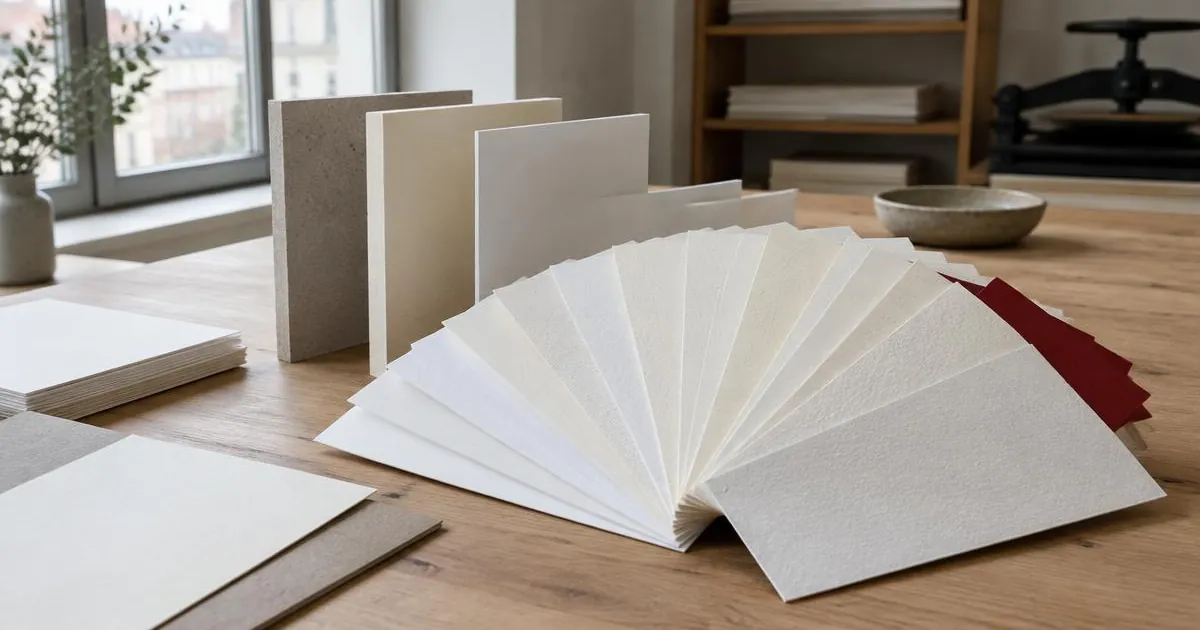
Paper weight in Europe is given in grams per square metre, written g/m² or gsm. It tells you how much one square metre of a paper weighs, so 80 gsm office paper is light and flexible, while 300 gsm board feels stiff like a postcard. This guide explains what paper weight means, how it relates to thickness, and which weights are common starting points for brochures, flyers, cards and packaging.
What does paper weight in gsm mean?
The international term is grammage, and the method for measuring it is set out in ISO 536, Paper and board, Determination of grammage. As papersizes.org explains, grammage is expressed in grams per square metre, and gsm is simply the everyday abbreviation.
The A paper sizes in ISO 216 make the arithmetic easy. An A0 sheet has an area of exactly one square metre, so one A0 sheet of 80 gsm paper weighs 80 grams. A4 is one sixteenth of A0, so a sheet of 80 gsm A4 weighs 5 grams.
Paper weight and postage
Because the maths is simple, you can estimate mailing weight before you print. A 16-page A4 brochure has 8 leaves, which is half a square metre of paper, or 65 grams on 130 gsm. Add a 4-page cover on 250 gsm, another eighth of a square metre or about 31 grams, and the brochure weighs roughly 96 grams before the envelope. A small change in paper weight can move a mailing into a different postage band, so check this early.
Is paper weight the same as thickness?
No. Grammage measures mass per area, while thickness, also called caliper, is measured in micrometres. Thickness, density and bulk are covered by a separate standard, ISO 534. Two papers with the same weight can differ in thickness:
- Coated papers (gloss, silk, matt) are denser, so they often feel thinner and smoother than an uncoated paper of the same gsm.
- Uncoated and high-bulk papers feel thicker and more substantial at the same weight.
- Board for packaging is often specified both in gsm and in micrometres, because stiffness on a filling line depends on thickness as much as weight.
If thickness matters, for example for a business card or a carton, ask the printer for the caliper of the exact paper, not just the gsm.
Which paper weight should you choose?
The table gives common starting points for discussion with your printer. They are not rules: the right paper weight depends on the paper type, format, folding and the impression you want to make. Office paper is usually 70 to 80 gsm, and papers above about 120 gsm start to behave like card, according to papersizes.org.
| Product | Typical starting range | Notes |
|---|---|---|
| Letterheads, forms | 80 to 120 gsm | Must run through office printers |
| Flyers and leaflets | 115 to 170 gsm | Heavier stock feels more premium |
| Brochure inside pages | 100 to 170 gsm | Heavier paper adds postage weight |
| Brochure covers | 200 to 300 gsm | Check folding and creasing |
| Postcards, invitations | 300 to 400 gsm | Check postal requirements before printing |
| Business cards | 300 gsm and up | Ask for the caliper as well |
| Folding cartons | Specified by board grade, gsm and caliper | Agree with the packaging supplier |
Folding heavier paper
Heavier papers and board usually need creasing before folding, or the fibres can crack along the fold, especially when ink covers it. Tell the supplier if a printed product will be folded, so the quote includes creasing.
Paper weight in colour standards
Offset colour standards use reference papers too, and Fogra's characterisation data, for example, list paper types such as 115 g/m² glossy coated and 115 g/m² uncoated white offset as reference substrates (Fogra, Characterisation data). The paper type, not just the weight, decides which colour profile the printer will use.
Coated or uncoated: the other half of the choice
Buyers often focus on the number and forget the surface. The finish changes how the same weight looks, feels and prints.
Gloss, silk and matt coated
Coated papers have a smooth surface layer that keeps ink on top of the sheet. Images look sharp and colours bright, which suits product photography, catalogues and premium flyers. Gloss reflects more light; silk and matt are easier to read under office lighting.
Uncoated
Uncoated paper absorbs more ink, so colours look softer and slightly darker. It is easy to write on, which is why letterheads, forms and notebooks use it, and it has a natural feel that many brands like for reports and invitations. If your brand colour must match on both coated and uncoated items, mention it in the request, because the same ink will look different on each.
Paper weight in pounds: converting US specifications
In North America, paper is described by basis weight in pounds, which is the weight of a ream of the uncut sheet size for that paper type. Because the uncut size differs between types, 28 lb bond and 28 lb cover are not the same paper. When a US specification arrives, ask the supplier to confirm the equivalent in gsm rather than converting it yourself.
How to specify paper weight in a request
- State the weight in gsm and the paper type, for example 150 gsm silk coated.
- Give separate weights for cover and inside pages.
- Mention any environmental requirement, such as recycled fibre or a certified paper.
- Ask for a paper sample or a blank dummy for important jobs, so you can feel the weight before printing.
- Say whether the product will be folded, bound, laminated or written on, because each affects the best choice.
If you are unsure, describe the result you want instead of a number, for example a sturdy cover that survives a trade fair or a light insert for a mailing. A good printer will suggest two or three options with prices, and the difference between them is often smaller than buyers expect.
The printing buyer resource pack includes a specification template. Paper choice also affects which press is best, which we cover in offset vs digital printing.
Get quotes with the right paper
On Flobid you can send one specification to several printers and compare quotes side by side. For brochures and catalogues, start a request in the brochures and catalogues category and include your paper weight, paper type and quantity.
Sources
- ISO 536:2019 Paper and board, Determination of grammage, ISO (2019)
- ISO 216:2007 Writing paper and certain classes of printed matter, Trimmed sizes, A and B series, and indication of machine direction, ISO (2007)
- ISO 534:2011 Paper and board, Determination of thickness, density and specific volume, ISO (2011)
- ISO 536 Paper Weights 80gsm, 90gsm, 120gsm, US and Canada 20lb, 24lb, papersizes.org
- Characterisation data, Fogra
Frequently asked questions
What does gsm mean on paper?
Grams per square metre, meaning the weight of one square metre of that paper, measured according to ISO 536. An A4 sheet of 80 gsm paper weighs 5 grams because A4 is one sixteenth of a square metre.
Is a higher gsm always thicker?
Usually, but not always, because coated papers are denser than uncoated ones, so two papers with the same gsm can have different thickness. Ask for the caliper in micrometres if thickness matters.
What paper weight is best for flyers?
Many flyers are printed on roughly 115 to 170 gsm, but the right choice depends on the paper type, size and how premium the flyer should feel, so ask the printer for samples.