
CBAM Explained for Importers: Steel, Aluminium and the 50 Tonne Threshold
What the EU Carbon Border Adjustment Mechanism means from 2026, who needs to become an authorised CBAM declarant, and why most buyers of aluminium display parts fall below the threshold.
5 min read
CBAM, the EU's Carbon Border Adjustment Mechanism, puts a carbon price on certain goods imported into the EU, including iron, steel and aluminium. Its definitive period started on 1 January 2026, but a simplification adopted in 2025 exempts importers that bring in no more than 50 tonnes of covered goods a year. For many buyers of display parts and metal fittings, the first task is simply to check whether they are above or below that line.
This article is general information, not legal, tax or customs advice.
What is CBAM and why does it exist?
CBAM was set up by Regulation (EU) 2023/956. Its purpose is to prevent carbon leakage: production moving to countries outside the EU with a lower carbon cost, or none. Importers pay for the embedded emissions of covered goods, much as producers inside the EU pay under the EU Emissions Trading System.
The Irish Environmental Protection Agency's overview of the EU Carbon Border Adjustment Mechanism confirms that the definitive phase began on 1 January 2026. From then on, covered imports carry a financial obligation, although the certificates for 2026 imports are bought and surrendered in 2027.
Which goods are covered?
The mechanism covers six sectors, listed by CN code in Annex I of the regulation:
- iron and steel;
- aluminium;
- cement;
- fertilisers;
- hydrogen;
- electricity.
The list goes further than raw metal, and according to the Annex I list of goods, aluminium headings include 7604 (bars, rods and profiles), 7610 (structures and parts of structures) and 7616 (other articles of aluminium). Iron and steel headings include 7308 (structures), 7318 (screws, bolts and similar fasteners) and 7326 (other articles of iron or steel). The correct CN code decides whether a product is in scope, so start with our guide to HS and CN codes.
Which countries are excluded?
Goods originating in Norway, Iceland, Liechtenstein and Switzerland are not subject to the mechanism, as the Swiss State Secretariat for Economic Affairs explains on its page about the EU CBAM. SECO adds a detail that is easy to miss: the EU uses its non-preferential rules of origin here, not the preferential rules from trade agreements.
The 2025 CBAM simplification and the 50 tonne threshold
Before the definitive period started, the EU adopted Regulation (EU) 2025/2083, which entered into force on 20 October 2025. The European Parliament's summary of the simplification sets out the main change: imports of up to 50 tonnes per importer per year are not subject to CBAM rules.
The threshold is designed so that at least 99 percent of embedded emissions stay in scope. In other words, a small number of large importers carry almost all of the obligation, while most occasional importers drop out.
How the threshold works in practice
- It is one mass-based threshold per calendar year for all covered goods together, excluding hydrogen and electricity, which are covered in any quantity (EPA).
- The Commission reviews the threshold every year and can change it by delegated act if the calculated value moves by more than 15 tonnes.
- An importer that expects to go over 50 tonnes must apply for, and obtain, authorised CBAM declarant status before it exceeds the threshold.
- Importers that applied by 31 March 2026 could keep importing during 2026 while their application was being processed.
What authorised CBAM declarants have to do
Above the threshold, the rules become an annual cycle of reporting and paying.
- Get authorised: obtain declarant status before importing covered goods above the threshold.
- Collect emissions data: calculate the embedded emissions of the goods using either default values or actual values verified by accredited verifiers, as the EPA explains.
- Declare and surrender: submit the annual CBAM declaration and surrender certificates by 30 September of the year after import, according to the EPA.
CBAM certificates and their price
For 2026 imports, certificates are priced per quarter as the average of EU ETS auction clearing prices, and declarants buy them from February 2027, as KPMG reported when the first CBAM certificate price was published in April 2026. Where a carbon price has actually been paid in the country of production, and the declaration uses actual emissions data, the number of certificates to surrender can be reduced.
Does CBAM affect buyers of steel or aluminium display parts?
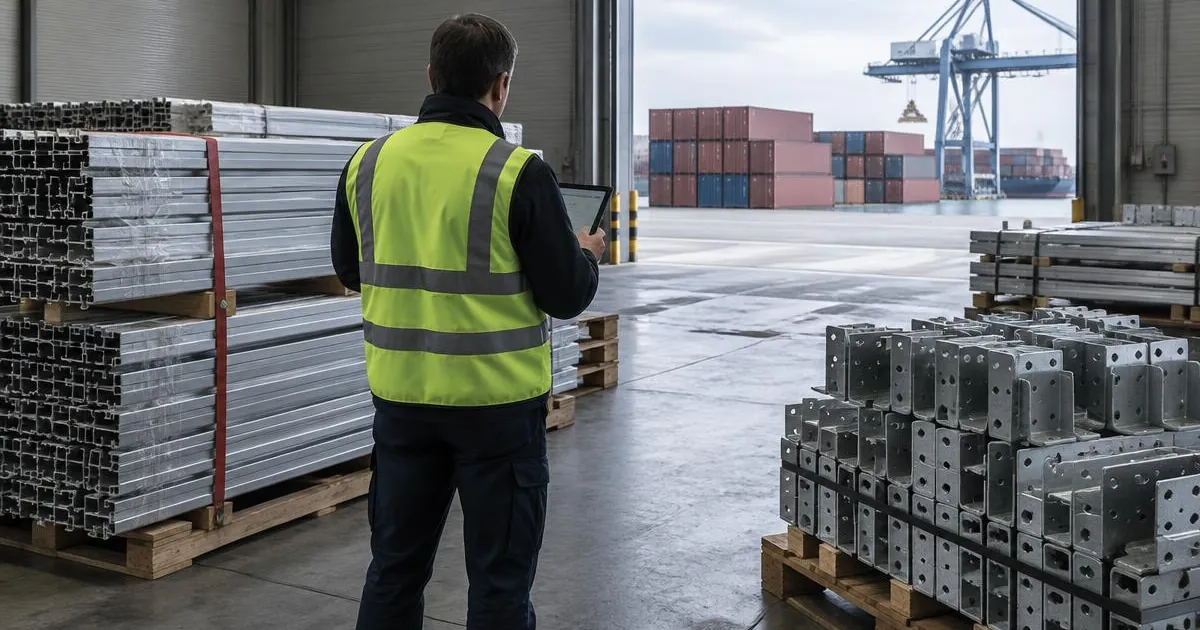
Exhibition stands, shop fittings and signage often use aluminium profiles, frames and steel fixings, so the question comes up often. Importers should keep the following practical points in mind:
- Buying from an EU supplier: CBAM applies when goods are imported into the EU. If your stand system or letter coil comes from a supplier inside the EU, any obligation sits with whoever imported the goods or the metal into the EU, not with you as a buyer.
- Buying from Norway or Switzerland: goods originating there are out of scope, although customs formalities still apply.
- Importing directly from outside the EU: check the CN codes of what you buy. Aluminium profiles, frames and fittings may fall under covered headings, while a finished product classified elsewhere may not.
- Adding up the tonnage: the 50 tonne threshold covers all your covered goods for the year. A company importing a few pallets of aluminium frames is likely to stay well below it, but a group buying structural steel as well should check the total.
The proposed extension to downstream products
This could change, because on 17 December 2025 the Commission proposed extending CBAM to 180 downstream products with a high steel or aluminium content, around 79 percent on average, according to the European Parliament's briefing on the downstream extension. Most are industrial supply chain products, such as base metal mountings, cylinders and industrial radiators. When the briefing was last updated in July 2026 the proposal was still going through the legislative procedure, so check its status before you plan long-term imports.
Sourcing aluminium and steel parts with CBAM in mind
When you compare quotes, ask each supplier where the metal parts are produced and which CN codes apply. For non-EU offers, factor in whether the goods would push you over the threshold, and who would handle the customs formalities. Your EORI number is needed for any import declaration.
On Flobid you can send one request to suppliers that deliver to your country, for example for aluminium profiles and letter coil or modular stand systems, and ask them to state origin and CN codes in their quotes.
Sources
- Regulation (EU) 2023/956 establishing a carbon border adjustment mechanism, EUR-Lex, Publications Office of the European Union (2023)
- EU Carbon Border Adjustment Mechanism, Environmental Protection Agency, Ireland
- Regulation (EU) 2023/956, Annex I: List of goods and greenhouse gases, Climate Action Authority, Malta
- Carbon Border Adjustment Mechanism (EU CBAM), State Secretariat for Economic Affairs SECO, Switzerland
- Regulation (EU) 2025/2083 amending Regulation (EU) 2023/956, EUR-Lex, Publications Office of the European Union (2025)
- Carbon Border Adjustment Mechanism: simplification and strengthening, European Parliament, Legislative Observatory
- EU: First carbon border adjustment mechanism (CBAM) certificate price now available, KPMG TaxNewsFlash (2026)
- CBAM extension to downstream products, European Parliamentary Research Service (2026)
Frequently asked questions
When did the CBAM definitive period start?
The definitive period of CBAM started on 1 January 2026. Certificates covering 2026 imports are bought from February 2027 and surrendered with the annual declaration.
What is the CBAM 50 tonne threshold?
Importers bringing in up to 50 tonnes of CBAM goods per calendar year are exempt from the CBAM rules. Hydrogen and electricity are excluded from the threshold and covered in any quantity.
Are aluminium profiles covered by CBAM?
Aluminium bars, rods and profiles (heading 7604), aluminium structures (7610) and other articles of aluminium (7616) are listed in Annex I. They only create an obligation when imported into the EU by an importer above the threshold.
Does CBAM apply to goods from Norway or Switzerland?
No. Goods originating in Norway, Iceland, Liechtenstein and Switzerland are not subject to CBAM, based on the EU's non-preferential rules of origin.