

Offset vs Digital Printing: Which Is Right for Your Print Job?
Offset has higher set-up costs but cheaper copies; digital has no plates but a higher unit price. How to choose and how to get comparable quotes.
5 min läsning
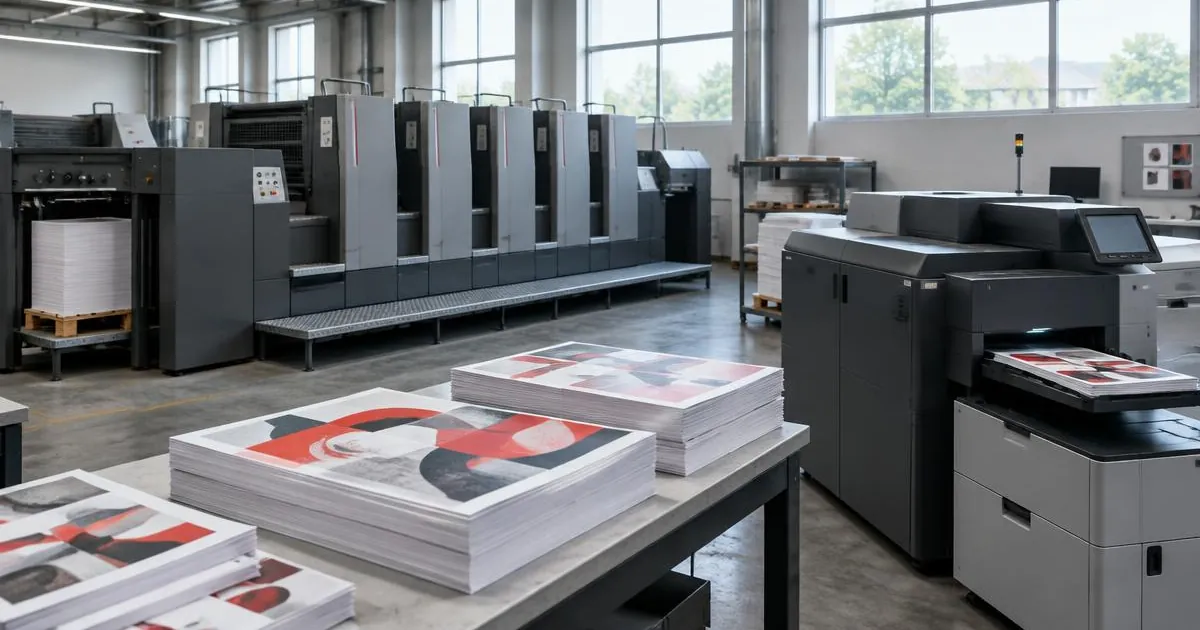
Offset vs digital printing comes down to one trade-off: offset has higher set-up costs but a lower cost per copy, while digital has almost no set-up but a higher cost per copy. That makes digital the usual choice for short runs, personalised items and fast jobs, and offset the usual choice for long runs, exact spot colours and special papers. Where the switch happens depends on the job and on each printer's equipment, so the best way to know is to ask for both prices.
How offset and digital printing work
Offset lithography
In offset printing, the artwork is separated into colours and each colour gets its own printing plate. Ink goes from the plate to a rubber blanket and from there to the paper. The process is standardised in ISO 12647-2, which sets process parameters for four-colour sheet-fed and web-fed offset, from colour separation and proofing to production printing. Making plates and bringing the press to colour takes time and paper, which is the fixed cost of every offset job.
Digital printing
Digital presses, using toner or inkjet, print directly from the file without plates. Every sheet can be different, which allows variable data such as names, numbers or versions. Print quality for digital commercial work is described in ISO/TS 15311-2, a specification written to help print buyers assess printed products, although it deliberately leaves process tolerances to each application.
Offset vs digital printing compared
| Factor | Offset | Digital |
|---|---|---|
| Set-up | Plates and make-ready for every job | Little or none |
| Cost per copy | Falls steeply with volume | Fairly flat at any volume |
| Turnaround | Longer, plus drying and finishing | Often faster for short runs |
| Personalisation | Not practical | Every sheet can differ |
| Spot colours | Mixed Pantone inks possible | Usually simulated from CMYK, depending on the press |
| Paper choice | Very wide range | Depends on press; check heavy, textured or uncoated stocks |
Where is the crossover between offset and digital?
There is no single number, and in a Printing Impressions survey of US printers from 2014, shops gave crossover points ranging from about 500 to about 1,500 copies for static jobs, and every printer explained it differently. Factors they named included click charges on digital presses, the cost of bindery work, page count, registration on folded products and how quickly the customer needed the job.
Today's presses have moved on, so treat these figures as an illustration of the logic, not a rule. For your own job, the crossover depends on:
- Number of colours and sides. More plates mean more set-up work on an offset press.
- Format and paper. Large sheets and special stocks may favour offset.
- Finishing. Folding, binding and die-cutting often cost the same either way and can dominate the price.
- Versions. Ten regional versions of 200 copies each behave like ten short runs.
- Printer's equipment. A shop with a large digital press and a small offset press will quote differently from one with the opposite set-up.
When to choose offset or digital printing
Choose offset when
- The run is long, for example catalogues, magazines or folding cartons in volume.
- You need exact brand colours mixed as spot inks. Pantone's Formula Guide shows spot colours on both coated and uncoated stock as a reference.
- You want a specific paper, a very heavy board or a special coating.
- Colour must match earlier offset runs closely, and offset printers often work to standard printing conditions, such as the FOGRA characterisation data sets for coated and uncoated sheet-fed offset listed by Fogra.
Choose digital when
- The run is short, or you need a test batch before the main order.
- Each copy carries different data, such as names, codes or numbered tickets.
- Speed matters more than the lowest unit price.
- You want to print on demand and avoid stock that may become out of date.
Hybrid jobs
Some jobs use both: offset for the static cover in volume and digital for personalised inside pages, or offset-printed packaging with a digitally printed batch label. Ask suppliers whether a hybrid route would lower the total cost.
Timing can also decide which printing method makes sense. If a trade fair is ten days away and the brochure is not yet approved, a digital run of a few hundred copies may be the only realistic option, with a larger offset reprint ordered once the content is final. Splitting the order this way costs a little more per copy at first but avoids paying for rush offset production.
Offset vs digital printing quality: can you see the difference?
For most brochures, flyers and business stationery, a reader will not notice which process was used. Differences tend to show in a few places: large areas of flat colour, very fine text reversed out of a dark background, metallic or fluorescent spot colours, and some uncoated or textured papers where toner and ink behave differently. If the look matters, ask each supplier for a printed sample on the paper you plan to use, not on their best demonstration stock.
Consistency over time is another point, since a job reprinted every quarter should look the same each time. Ask how the printer controls colour on the process they propose, and whether they can print a proof against the agreed standard before the run.
Offset vs digital printing for packaging
The same logic applies to folding cartons, labels and corrugated boxes. Large, repeating orders of the same carton usually suit offset or flexo, because the tooling cost spreads over many units. Digital packaging print is used for prototypes, market tests, seasonal designs and many versions in small quantities. Die-cutting and gluing follow either way, so the printing method is only part of the total price. For corrugated boxes, see our article on digital printing on corrugated packaging.
How to get comparable quotes
To compare offset vs digital prices fairly, send the same specification to every supplier: format, page count, paper weight and finish, colours, quantity breaks, finishing and delivery. Ask for prices at two or three quantities, such as 250, 1,000 and 5,000, so you can see where the curves cross for your job. Our guides to paper weight and CMYK vs Pantone help you write that specification.
Request both options on Flobid
On Flobid you can send one request to several printers and see the quotes side by side. Use offset printing for longer runs or short-run digital print for small batches, and mention in the request that you are open to either method.
Sources
- ISO 12647-2:2013 Graphic technology, Process control for the production of half-tone colour separations, proof and production prints, Part 2: Offset lithographic processes, ISO (2013)
- ISO/TS 15311-2:2018 Graphic technology, Print quality requirements for printed matter, Part 2: Commercial print applications utilizing digital printing technologies, ISO (2018)
- Printers Share Crossover Points for Running Shorter-Run Static Print Jobs Offset vs. Digital, Printing Impressions (2014)
- Characterisation data, Fogra
- Formula Guide Set, Coated and Uncoated, Pantone
Vanliga frågor
Is offset or digital printing cheaper?
It depends on the quantity, since digital is usually cheaper for short runs because there are no plates, while offset becomes cheaper per copy as volume rises. Ask for prices at several quantities to find the crossover for your job.
Can digital printing match Pantone colours?
Many digital presses simulate spot colours from CMYK, and some colours cannot be matched exactly. If an exact Pantone colour is critical, offset with mixed spot ink is the safer choice.
What is variable data printing?
Printing where each copy carries different content, such as names, numbers or codes. It is only practical with digital printing, because offset uses fixed plates.