

Large Format Printer Guide: UV vs Latex vs Eco-Solvent
UV, latex or eco-solvent: a neutral comparison of large format printer technologies, the materials and jobs each suits, and what to check before you buy or order.
5 min de lectura
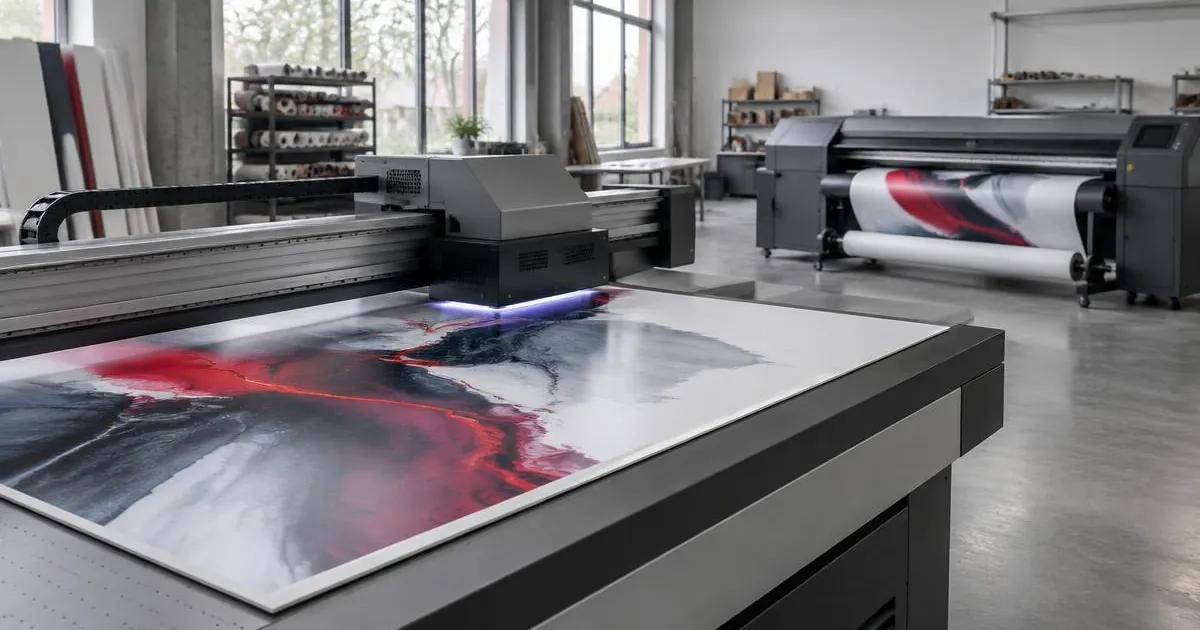
Choosing a large format printer mostly comes down to the ink. UV curable printers cure ink instantly with ultraviolet light and print on almost any rigid or flexible material. Latex printers use water-based resin inks that are dried with heat and can be handled straight away. Eco-solvent printers use mild solvent inks that bite into coated vinyl and are a long standing choice for vehicle graphics and outdoor signs.
This guide compares the three technologies neutrally, so you can understand quotes from print suppliers or narrow down a machine purchase.
What does wide-format printing cover?
A large format printer, also called a wide-format printer, is an inkjet printer that prints on rolls or boards wider than standard office sizes. These machines are built in three main configurations:
- Roll-to-roll: prints on flexible media such as vinyl, banner material, paper and textiles
- Flatbed: the media lies on a table, which allows printing on rigid boards, wood, glass or metal
- Hybrid: combines roll feeding with support for rigid boards
Within each configuration, the ink chemistry decides which materials work, how durable the print is and how quickly it can be finished. Other ink families exist too: aqueous printers are mainly used indoors for posters, photos and technical drawings, and dye-sublimation printers are built for polyester textiles. This guide focuses on the three technologies most often compared for signage and display work.
How do UV, latex and eco-solvent inks differ?
UV curable ink
According to FESPA's guide to inkjet and wide-format printing, UV inks are cured with UV energy, which allows printing on both flexible and rigid materials, including paper, board, vinyl, wood, metal and textiles, often without a special coating. Prints are hard wearing and resist weather and abrasion. Flatbed machines give tougher finishes than roll-fed ones, which need more flexible inks. The finish is generally flatter and more matte, although some machines can vary curing for a glossier look.
A primer published by In-plant Impressions adds that LED UV produces little heat, which suits heat sensitive materials such as thin polypropylene and fluted plastic board. UV ink is less flexible than eco-solvent or resin inks, although elastic formulations exist.
Latex (resin) ink
Latex ink is a water-based resin ink that needs substantial heat to dry. FESPA notes that prints need no de-gassing and can be used immediately, and that latex is common for exhibition graphics and soft signage on textiles. The In-plant Impressions primer explains that a synthetic resin activates when heated and encapsulates the pigment, and that latex is HP's brand name for resin-based ink. It lists indoor and outdoor signage, fabric, vehicle wraps and wallcoverings as typical uses.
Eco-solvent ink
Modern mild or eco-solvent inks contain low levels of solvent. FESPA describes them as cost effective and versatile, usually used on coated media, with self-adhesive vinyl as the most common material and vehicle graphics as the most common application. Prints should generally be left for up to 24 hours to de-gas before lamination or use. The primer notes good outdoor durability and water resistance, a possible odour if ventilation is poor, and lower scratch resistance than UV or resin inks.
Large format printer technologies compared
| Aspect | UV curable | Latex (resin) | Eco-solvent |
|---|---|---|---|
| How the ink sets | Cured instantly by UV light | Dried and cured by heat | Solvent evaporates, ink bonds to coated media |
| Waiting before finishing | None | None | De-gassing, up to about 24 hours |
| Rigid boards | Yes, on flatbed and hybrid machines | Mainly roll media | Mainly roll media |
| Typical uses | Rigid signs, POS boards, window graphics, decals | Indoor and outdoor signs, textiles, wallcoverings | Vehicle graphics, outdoor vinyl, banners |
| Flexibility of ink film | Lower, elastic inks exist | Flexible | Flexible, stretches well on cast vinyl |
A comparison published by Large Format Review, based on a reseller that sells all three types, adds that solvent ink penetrates and bonds with the media and suits cast vinyl for wraps, that UV sits on top of the surface and cures with minimal heat, and that latex prints can be finished and laminated straight off the machine. The same comparison notes that latex can stretch less than solvent on cast vinyl.
Which large format printer suits which job?
Rigid signs and displays
Printing directly on foam board, aluminium composite, corrugated board or acrylic points to UV, usually on a flatbed or hybrid machine. Direct printing avoids mounting a printed vinyl on board, which saves a production step.
Vehicle wraps and conformable graphics
Wraps need ink that stretches with cast film over curves. Eco-solvent has long been used here, and latex is also used. The film, laminate and installer matter as much as the ink, so ask suppliers which combination they use and what lifetime they expect for your application.
Indoor graphics, textiles and fast turnaround
Latex suits indoor graphics, wallcoverings and some textiles, and the lack of de-gassing helps when jobs must be finished the same day. For fabric display graphics, dye-sublimation is also common; see our dye-sublimation printing guide. Banner stands and similar products are often printed on any of these technologies, so compare quotes on the finished result; our roll-up banner sizes guide helps with the specification.
What to check before buying a machine
- Your main materials: list the five materials you print most and test them on each machine you consider
- Finishing flow: check whether you need same-day lamination and cutting
- Workspace: check ventilation, power and heat output against the supplier's installation requirements
- Running costs: ask for ink use per square metre on your own files, plus print head and service costs; the In-plant Impressions primer notes that print head types differ in how often they need replacing
- Certificates: if you sell into schools, healthcare or interiors, ask which environmental or indoor air certificates apply to the ink and printed media
Getting quotes for printers or printed work
On Flobid, you can send a request for large format printers to machine suppliers who deliver to your country, describing width, materials and expected volume. For printed products rather than machines, describe the finished item and let print suppliers choose the process. Our FESPA 2026 recap covers the latest developments shown at the main wide-format fair.
Sources
- Understanding the basics of inkjet and wide format printing, FESPA (2016)
- Primer: A Guide to Wide-Format Printing Inks, In-plant Impressions (2024)
- A comparison of solvent, UV and latex from Granthams who sell them all, Large Format Review (2019)
Preguntas frecuentes
What is the difference between UV and latex printers?
UV printers cure ink instantly with ultraviolet light and can print on rigid boards. Latex printers use water-based resin inks dried with heat and mainly print on roll media.
Why do eco-solvent prints need to de-gas?
The solvent in the ink needs time to evaporate. FESPA advises leaving prints for up to 24 hours before laminating or using them.
Which large format printer is best for vehicle wraps?
Wraps need a flexible ink printed on cast film. Eco-solvent has long been used and latex is also used; the film, laminate and installation matter as much as the ink.