

Triangulation VAT in the EU: How Triangular Transactions Work
How the EU triangulation simplification lets a middle business avoid VAT registration abroad, what the invoice must say and what changed after a December 2025 ruling.
5 min read
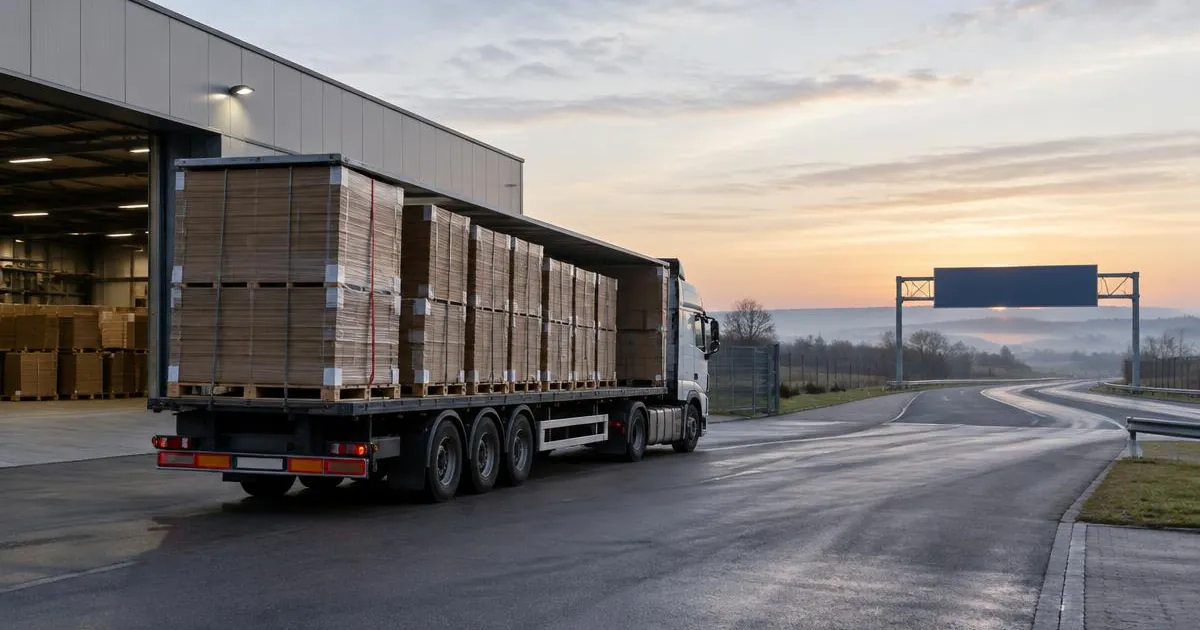
Triangulation in EU VAT is a simplification for chain sales where three businesses in three member states trade the same goods, but the goods travel only once, directly from the first seller to the last buyer. Without it, the business in the middle would normally have to register for VAT in the buyer's country. With triangulation, the final customer accounts for the VAT instead, and the middle business only needs correct invoices and reporting at home.
This article is general information, not tax advice. Triangular deals are easy to get wrong, so check each case with an adviser.
What is triangulation in EU VAT?
Picture a typical packaging deal, in which a carton maker in Germany (A) sells to a distributor in the Netherlands (B). The distributor resells the same cartons to a food producer in Poland (C). To save time and freight, the cartons go by truck straight from Germany to Poland.
Legally there are two sales, A to B and B to C, but only one transport. One of the two sales is the cross-border intra-community supply. The other is treated as taking place in either the country of departure or the country of arrival. If B's sale is located in Poland, B would normally have to register for VAT there, and triangulation removes that need.
Conditions for the triangulation simplification
The rules are in Articles 141 and 197 of the EU VAT Directive (2006/112/EC). As summarised in a KPMG TaxNewsFlash of 4 December 2025, all of these must be met:
- The intermediary (B) is not established in the destination country (C's country) but holds a VAT number in another member state.
- B buys the goods to resell them in the destination country.
- The goods move directly from another member state to B's customer.
- The customer (C) holds a valid VAT number in the destination country.
- C is designated to account for the VAT under the reverse charge.
Article 42 of the directive adds that B must have met its recapitulative statement obligations to avoid VAT on its acquisition in the destination country.
Triangulation step by step: who does what?
The first seller (A)
A makes an exempt intra-community supply to B and invoices without VAT, quoting B's VAT number. A reports the sale to B in its EC Sales List as a normal intra-community supply.
The intermediary (B)
B invoices C without VAT, and the invoice must state that the reverse charge applies. In case C-247/21, Luxury Trust Automobil, the Court of Justice held that the words "Reverse charge" must appear, and that a phrase such as "Exempt intra-Community triangulation" was not enough. The error could not be corrected afterwards, according to BDO Belgium's summary of the 2023 ruling. B also reports the triangular sale in its own recapitulative statement. The Finnish Tax Administration explains that your role in the chain decides what you report (Vero.fi, EU VAT recapitulative statement), and Skatteverket lists resold goods in triangular trade as a separate item in the Swedish EC Sales List.
The final customer (C)
C accounts for VAT in its own country under the reverse charge and, if it has full deduction rights, deducts the same amount. For C, the purchase works much like any other reverse charge purchase.
A worked triangulation example
Take the carton deal again, with made-up figures for illustration. The German carton maker (A) invoices the Dutch distributor (B) EUR 10,000 without VAT, quoting B's Dutch VAT number. B invoices the Polish food producer (C) EUR 12,000 without VAT, with C's Polish VAT number and the words "Reverse charge". The truck goes directly from Germany to Poland.
C then declares Polish VAT on EUR 12,000 at the Polish standard rate, which is 23% according to the Your Europe VAT rates table, and deducts the same amount if it has full deduction rights. B pays no Polish VAT and files no Polish return. A and B each report their part in their own EC Sales Lists.
When the simplification does not help
If B is established in Poland, or uses a Polish VAT number for the deal, condition one fails and normal rules apply. The same is true if the goods first go to B's warehouse in the Netherlands and are then sent on to Poland: that is two separate movements, not one direct delivery.
Triangulation with four or more parties
For years many advisers held that the simplification only works for exactly three parties. On 3 December 2025 the EU General Court ruled in case T-646/24 that it can also apply in longer chains, for example where goods are delivered directly to the customer's own customer in the same member state. According to Wolf Theiss's analysis of 7 January 2026, the number of parties alone does not disqualify a chain, but every objective condition must still be checked against the facts. The court also confirmed that the simplification is lost if the business knew, or should have known, that the chain was part of VAT fraud.
Common triangulation mistakes
- Missing "Reverse charge" wording on the intermediary's invoice.
- Using the destination country's VAT number as the intermediary. B must use a VAT number from a country other than the destination.
- Forgetting the EC Sales List entry or reporting it as a normal supply. See our guide to the EC Sales List.
- Not checking VAT numbers. The customer must have a valid VAT number in the destination country. Use VIES, as described in how to check an EU VAT number.
- Poor transport records. Keep documents showing who arranged and paid for the transport and where the goods were delivered.
Can the transport arrangement change the result?
Yes, and which sale counts as the cross-border one depends on how the transport is organised, so the Incoterm and the party that books the truck matter. Agree this in writing before the first delivery.
Drop shipments through Flobid
Brokers and print management agencies often buy from one supplier and resell to a customer in a third country. When you post a request for quotation on Flobid, state the delivery country and who arranges transport, so suppliers can quote the right Incoterm and VAT treatment from the start.
Sources
- Council Directive 2006/112/EC of 28 November 2006 on the common system of value added tax, EUR-Lex (2006)
- EU: Triangulation simplification applies beyond three parties in EU VAT supply chains, KPMG (2025)
- The General Court clarifies triangular transactions rules in supply chains with more than three parties, Wolf Theiss (2026)
- Importance of correct invoice statement in simplified triangulation confirmed by Court of Justice, BDO Belgium (2023)
- VAT rules and rates: standard, special and reduced rates, Your Europe, European Commission (2026)
- VAT EU recapitulative statement, Finnish Tax Administration (2025)
- EC Sales List (recapitulative statement) regarding goods and services, Skatteverket
Frequently asked questions
What is a triangular transaction in EU VAT?
A chain sale between three businesses in three member states where the goods move once, directly from the first seller to the last buyer. Under the simplification, the last buyer accounts for the VAT so the middle business does not need to register in the buyer's country.
What must the intermediary's invoice say in triangulation?
It must state that the reverse charge applies. The Court of Justice held in case C-247/21 that the words “Reverse charge” are required and that a missing statement cannot be corrected afterwards.
Does triangulation work with four parties?
Possibly, since in case T-646/24 of 3 December 2025, the EU General Court held that the simplification can apply in longer chains if all conditions are met, for example when goods go directly to the customer's customer.