
Sustainable Packaging: What to Ask Your Supplier
The concrete questions that separate real sustainable packaging from green claims: certified fibre, recycled content, recyclable design, right-sizing and the EU PPWR.
5 min read
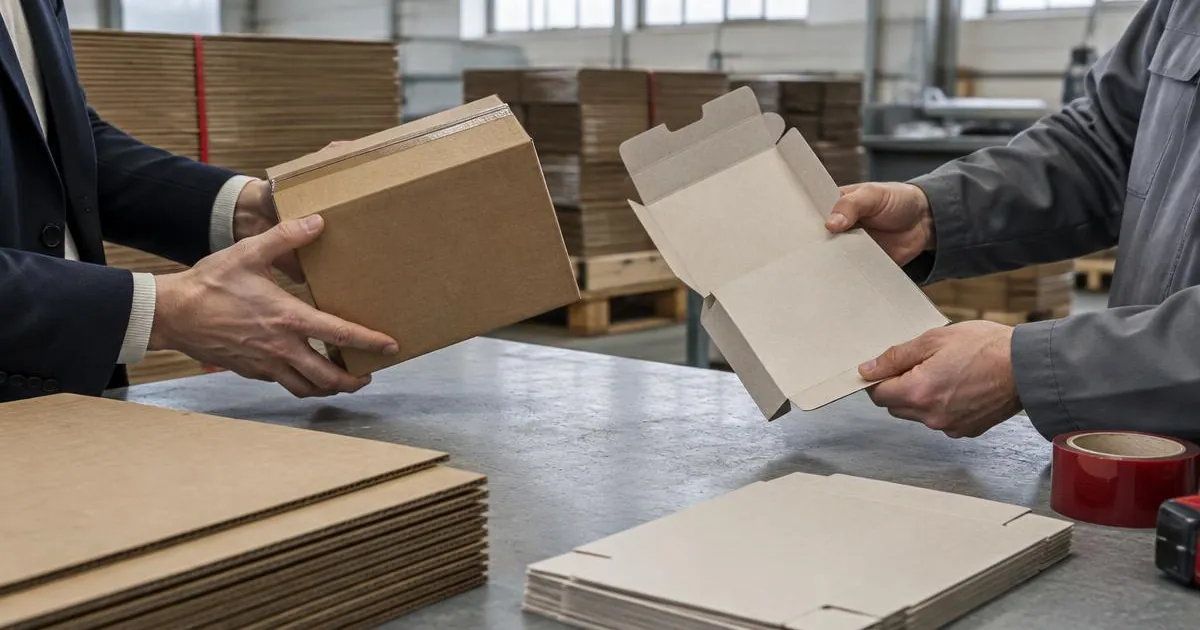
Sustainable packaging is packaging that protects the product with as little material as possible, uses responsibly sourced or recycled input and can be recycled where your customers live. Most suppliers will say their packaging is sustainable, but claims are easy to make and harder to check. The useful questions are concrete, and this guide lists them.
What makes packaging sustainable?
There is no single label for sustainable packaging. In practice, buyers look at five things together:
- Material use: no more material than the product needs.
- Source of the material: certified fibre from responsibly managed forests, or recycled content.
- Recyclability: a design that fits the collection and recycling systems in the countries where the packaging ends up.
- Substances: no harmful substances, especially for food-contact packaging.
- Transport efficiency: boxes that fill pallets and trucks well.
The rest of this guide turns each point into questions you can put to a sustainable packaging supplier.
FSC certification and certified fibre: what to ask
FSC and PEFC are the two main schemes that certify wood fibre from responsibly managed forests. For paper and board packaging, ask which scheme the supplier is certified under and which of your products the certificate covers.
What the FSC labels mean
FSC uses three on-product labels, and according to FSC, FSC 100% means all material comes from FSC-certified forests, FSC Recycled means 100 per cent recycled material, and FSC Mix combines certified, recycled and controlled material. A company must hold chain-of-custody certification before it can put the FSC label on any product, and its certificate does not mean that all its products are certified.
How to check a supplier's FSC certification
Ask for the certificate code and the trademark licence code. FSC explains that the certificate code must appear on sales documents to pass the claim down the supply chain, and that a product needs at least 70 per cent certified input under the percentage system to carry an on-product label; below that, the invoice can still carry a claim, but the product cannot carry the label. Then look the code up in the FSC public certificate database, which shows whether the certificate is valid and which product types it covers. A logo on a website is not proof.
PEFC as an alternative
PEFC works in a similar way, as a company that wants to sell products with a PEFC claim or label needs chain-of-custody certification, and a certificate lasts up to five years, with annual surveillance audits. If you want to compare the two schemes in detail, read FSC vs PEFC certification.
Recycled content and recyclable design
Corrugated board and many folding cartons already use recycled fibre, but the share differs by grade. For plastic packaging, recycled content is becoming a legal requirement as well as a buyer preference. Ask for documentation, not just a percentage in an email.
- Prefer mono-materials, such as all paper or one type of plastic, where the product allows it.
- Ask whether coatings, laminates, windows or metallised films could be removed or replaced without losing protection.
- Ask how the supplier expects the packaging to be graded under the coming EU recyclability criteria.
- Check whether inks, adhesives and labels fit the recycling stream.
Sustainable packaging and the EU PPWR
The EU Packaging and Packaging Waste Regulation (PPWR), Regulation (EU) 2025/40, sets common rules for all packaging placed on the EU market. It entered into force on 11 February 2025 and has applied since 12 August 2026, with several obligations phased in later. The table below lists dates that matter when you buy sustainable packaging, based on the European Parliament's summary of the adopted regulation and the Commission-backed Circular Economy Stakeholder Platform.
| Date | What applies |
|---|---|
| 12 August 2026 | General application; limits on PFAS in food-contact packaging |
| 12 August 2028 | Harmonised label showing material composition |
| 1 January 2030 | Packaging weight and volume reduced to the minimum needed; empty space ratio of at most 50 per cent for grouped, transport and e-commerce packaging |
| 2030 | Recyclability performance grades; minimum recycled content for plastic packaging, for example 30 per cent for single-use plastic beverage bottles; binding reuse targets, such as 40 per cent for transport packaging |
| 2035 | Packaging must be recycled at scale |
For a fuller overview, see our guide to the EU packaging regulation (PPWR).
How to spot vague sustainable packaging claims
Words such as "eco", "green" or "planet-friendly" tell you little on their own. A credible sustainable packaging offer names the material, the certificate and the evidence behind each claim.
Claims that need evidence
- "Recyclable": recyclable where, and in which collection system? Ask the supplier what the claim is based on.
- "Made from recycled material": what share, and is it documented by a certificate or a mill declaration?
- "Sustainably sourced": under which scheme, with which certificate code?
- "Biodegradable" or "compostable": under which conditions, and is there a collection route for it where your customers live?
If a supplier cannot back a claim with a document, treat it as marketing rather than as part of the specification. Keeping the evidence on file also helps when your own customers ask about your sustainable packaging.
Right-sizing: the most sustainable packaging is the one you do not use
A box that fits the product needs less filler, takes less space in transport and often costs less. The PPWR's minimisation and empty-space rules point in the same direction, so right-sizing now saves redesign work later. Ask the supplier to propose a smaller or lighter design with the same protection, and to test it if the product is fragile.
Questions to ask your sustainable packaging supplier
- Which material and grade do you propose, and why?
- Are you FSC or PEFC certified, and what is your certificate code?
- Does the certificate cover the exact product you are quoting?
- What share of recycled content does the material contain, and how is it documented?
- Is the design mono-material, and if not, can it be?
- How will the packaging be graded for recyclability under the PPWR?
- Can you reduce weight or size without losing protection?
- For food contact: how do you meet the PFAS limits and other food-contact rules?
- How many units fit on a pallet, and can that be improved?
- Which documents can you provide with the delivery?
Put your sustainable packaging requirements in the request
Write your requirements into the request for quotation, for example "FSC-certified board, mono-material, no plastic window". Then every supplier answers on the same basis and quotes are easier to compare. On Flobid, buyers can ask for certificates in a request for shipping boxes or printed folding cartons, and only checked certificates are shown on supplier profiles.
Sources
- The EU Packaging and Packaging Waste Regulation: when will it come into effect and what does it cover?, European Circular Economy Stakeholder Platform (2026)
- Packaging and packaging waste, document summary, Legislative Observatory, European Parliament (2025)
- What do the FSC labels mean?, Forest Stewardship Council
- FSC Claim, Labels, and Logo, Forest Stewardship Council
- Search, Forest Stewardship Council UK
- How to get PEFC chain of custody certified, PEFC
Frequently asked questions
How do I check that a supplier has FSC certification?
Ask for the FSC certificate code and look it up in the FSC public certificate database. Check that the certificate is valid and covers the products you buy.
What is the difference between FSC 100%, FSC Mix and FSC Recycled?
FSC 100% means all material comes from FSC-certified forests, FSC Recycled means 100 per cent recycled material, and FSC Mix combines certified, recycled and controlled material.
When does the EU packaging regulation apply?
Regulation (EU) 2025/40 entered into force on 11 February 2025 and has applied since 12 August 2026, with further obligations phased in, many of them from 2030.