

Printing and Packaging Lead Times: How to Plan Orders That Arrive on Time
Lead times include quoting, artwork, proofs, materials, production and transport. How to plan backwards from your deadline and what to ask suppliers.
5 min di lettura
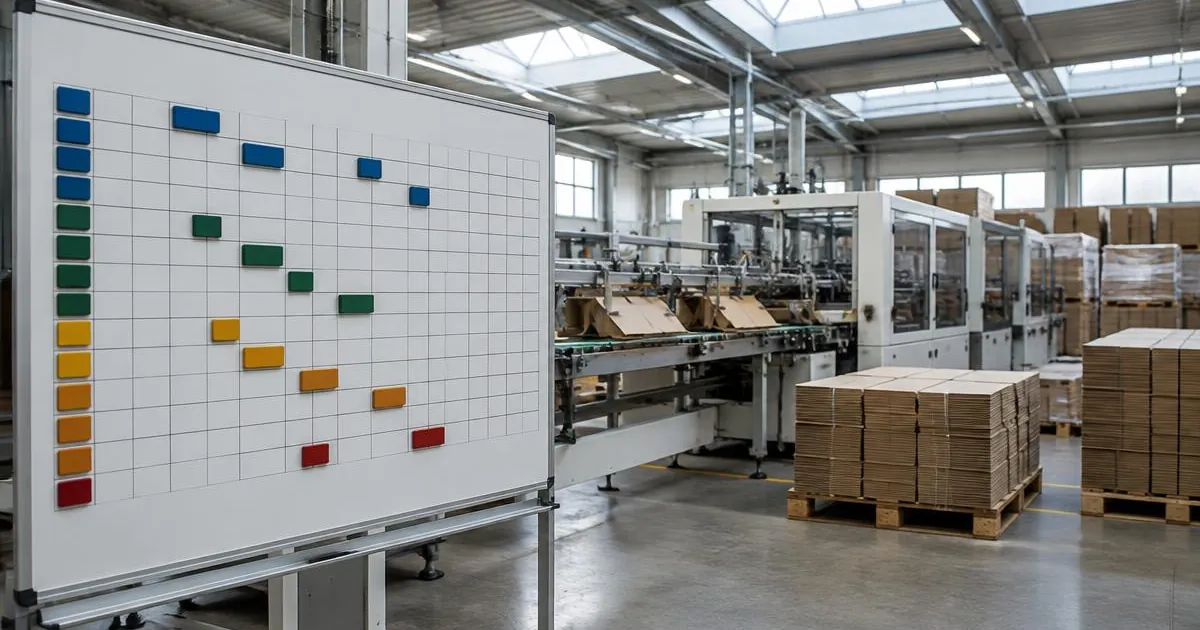
Lead times for printing and packaging are the total time from your first request to goods arriving at your door, not just the days on the press. They include quoting, artwork, proof approval, materials, production, finishing and transport, and the stages you control often take longer than the printing itself. The way to hit a deadline is to plan backwards from the delivery date and confirm each step with the supplier in writing.
What makes up print and packaging lead times?
A supplier's quoted lead time usually starts when they have approved files and a confirmed order, and ends when the goods leave their site. Everything before and after that is on top, and a full timeline looks like this:
| Stage | Who drives it | What to confirm |
|---|---|---|
| Specification and quotes | Buyer | All suppliers quote the same specification |
| Order and payment terms | Both | When the lead time starts counting |
| Artwork and files | Buyer or agency | File specification and checks |
| Proof and approval | Both | Proof type and approval deadline |
| Materials | Supplier | Paper, board or substrate in stock or to order |
| Tooling | Supplier | Plates, cutting dies, embossing tools |
| Printing and finishing | Supplier | Press slot, drying, lamination, die-cutting, gluing |
| Packing and transport | Supplier or forwarder | Incoterm, delivery address, delivery window |
Stages that stretch lead times
Specification and quotes
Unclear requests lead to questions, revised quotes and lost days. A complete specification, with format, quantity, material, colours, finishing, delivery address and date, lets suppliers quote quickly and accurately. Our guide on how to write a good RFQ lists what to include.
Artwork and file checks
Printers check every file before production, and a typical data check covers bleed, image resolution, colour mode, embedded fonts and minimum line widths, as shown in this packaging printer's file requirements. Each file that fails means a new round with the designer. Use our print-ready PDF checklist to get it right the first time.
Proofs and approvals
Colour-critical work needs a proof, and someone in your organisation must approve it. The offset standard ISO 12647-2 covers the whole chain from colour separation and proofing to the OK print and production run, which shows how many approval points a job can have. Internal approval by marketing, legal or management is often where days disappear, so name one approver and give them a deadline.
Materials and tooling
Standard papers and board grades are often in stock at the printer or a merchant. Special papers, coloured board, certified materials or unusual formats may need ordering. Packaging adds tooling: a new carton needs a cutting die, and embossing or hot-foil need their own tools. Ask the supplier whether materials and tools are available or must be ordered, and how that affects the lead time.
How production method affects lead times
Digital printing needs no plates and is often the faster route for short runs. Offset needs plates and make-ready but runs volume efficiently. In a 2014 Printing Impressions survey of US printers, one owner named timing, meaning how fast the customer needs the job, as the biggest factor when choosing between offset and digital. A short digital run can bridge a gap while a larger offset order is produced.
Finishing also takes time, because lamination, varnish and ink need to dry or cure before cutting, folding or gluing, and binding or carton gluing are separate operations that need their own machine slots.
How to plan lead times backwards
- Start with the date the goods must be in use, for example the first day of a trade fair, and add a buffer for unloading and setup.
- Subtract transport time confirmed by the supplier for your delivery address. Agree the Incoterm so it is clear who books and pays for freight; see Incoterms 2020 explained.
- Subtract the supplier's production lead time, and ask what it includes: materials, finishing and packing.
- Subtract proof approval, including internal sign-off.
- Subtract artwork and file checks.
- Subtract quoting and ordering. The result is the date you need to send the request.
Questions to ask every supplier
- When does your lead time start: at order, at payment, or at file approval?
- Is it in working days or calendar days?
- Are materials in stock for this job?
- Do you have planned shutdowns, such as summer or year-end holidays?
- Can you split delivery, sending part of the quantity early?
Lead times for cross-border orders
Buying from a supplier in another EU country can widen your choice and lower the price, but it adds transport distance and a few administrative steps. Within the EU there is no customs clearance, so goods move like a domestic delivery, only further. Ask for the transit time to your exact address, including any delivery restrictions such as tail-lift needs or fixed time slots at a venue.
The VAT side should be settled before production starts. The supplier needs your valid VAT number to invoice without VAT, and you should agree who arranges transport. Our guide to selling to business buyers in other EU countries covers both points from the supplier's side.
Rush orders: what can and cannot be sped up
Some stages of the timeline compress well, while others do not. Approvals, file corrections and transport booking depend mostly on people and can often be done in hours instead of days. Drying, curing and adhesive setting depend on materials and cannot be skipped without risking quality. Ordering special board or a new cutting die takes the time it takes.
If a deadline is tight, ask the supplier which parts of the job are on the critical path and whether a change of material, finish or quantity would save time. A standard paper instead of a special one, or a smaller first batch with the rest delivered later, is often the difference between making the date and missing it. Expect a surcharge for overtime or bumping other jobs, and ask for it to be stated in the quote.
Quality checks without losing time
Agree in advance how you will judge the delivered goods, so inspection does not turn into a dispute. For digital commercial print, ISO/TS 15311-2 gives print buyers metrics and methods for assessing printed products. For simpler jobs, an approved proof and a signed-off sample are often enough. Inspect deliveries promptly and report problems in writing.
Plan your next order on Flobid
Flobid lets buyers send one request to several printing and packaging suppliers and compare quotes side by side, including the lead time each supplier commits to. Add your required delivery date to the request so suppliers can confirm whether they can meet it. Start a request for quotation for free and compare the quotes side by side.
Sources
- ISO 12647-2:2013 Graphic technology, Part 2: Offset lithographic processes, ISO (2013)
- ISO/TS 15311-2:2018 Graphic technology, Print quality requirements for printed matter, Part 2: Commercial print applications utilizing digital printing technologies, ISO (2018)
- Printers Share Crossover Points for Running Shorter-Run Static Print Jobs Offset vs. Digital, Printing Impressions (2014)
- Data check, ideas in boxes
Domande frequenti
When does a printer's lead time start?
Usually when the order is confirmed and the files or proof are approved, not when you first ask for a quote. Ask each supplier to state this in the quote.
How can I shorten lead times for printing?
Send a complete specification, supply print-ready files, name one person to approve proofs quickly and choose materials the supplier has in stock. For urgent short runs, digital printing can be faster.
Why do packaging orders take longer than flat print?
Packaging often needs extra steps such as cutting dies, die-cutting, gluing and sometimes special board, each with its own lead time.