

FEFCO Codes Explained: Choosing the Right Corrugated Box
FEFCO codes give every corrugated box style a number. Learn how the series work, what 0201 and 0427 mean, and how to specify a box so suppliers quote the same thing.
5 min de lecture
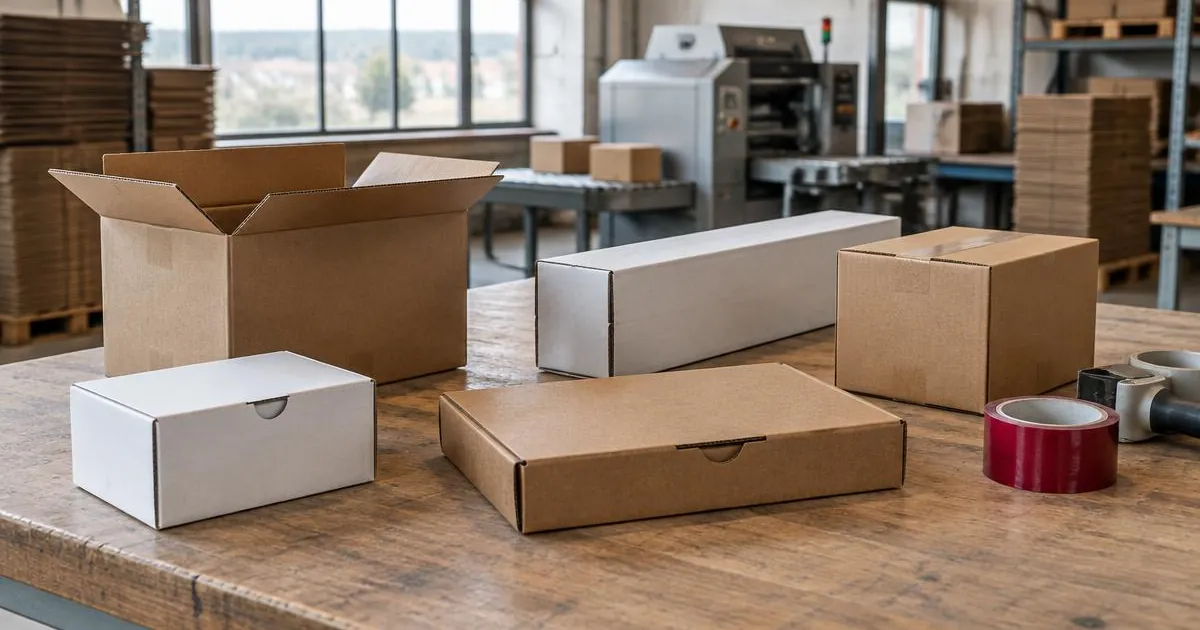
FEFCO codes give every corrugated box style a four-digit number, so a buyer in Sweden and a box supplier in Poland mean exactly the same construction when they say 0201. The code is published by FEFCO, the European corrugated packaging federation, together with ESBO, and is used across the corrugated industry.
This guide explains how FEFCO codes are grouped, the styles buyers ask for most, how to give dimensions and how to write a box specification that gets comparable quotes.
What are FEFCO codes?
FEFCO describes its code as an official system to substitute long and complicated verbal descriptions of fibreboard case and packaging constructions with simple symbols that can be understood internationally, whatever the language. The code has also been adopted by the International Corrugated Case Association, and the current edition is the 11th.
In practice, the number tells the supplier the construction: how the blank is cut and folded, where the joint is and how the box closes. It does not tell them the size, the board or the print, which you add yourself.
How FEFCO codes are grouped
The first two digits give the series, and the published code of designs groups the styles like this:
| Series | Type | What it means |
|---|---|---|
| 01 | Rolls and sheets | Commercial rolls and sheets, not a box style |
| 02 | Slotted-type boxes | One-piece blank with a joint and top and bottom flaps |
| 03 | Telescope-type boxes | A lid and/or bottom that slides over the body |
| 04 | Folder-type boxes and trays | Usually one piece, with the base hinged to form walls and cover |
| 05 | Slide-type boxes | Liners and sleeves that slide into each other |
| 06 | Rigid-type boxes | Two separate end pieces and a body, joined before use |
| 07 | Ready-glued cases | Shipped flat and set up by simple erection |
| 09 | Interior fitments | Liners, pads, partitions and dividers |
FEFCO 0201: the slotted shipping box
0201 is in the slotted-type series: one blank, a glued, stitched or taped joint, and flaps that close the top and bottom. The code marks it as suitable for manual or automatic erection, so it works for hand packing and for packing lines.
FEFCO 0427: the mailer box
0427 is in the folder-type series and is marked for manual erection. Packaging suppliers commonly sell it as a corrugated mailer box, including versions with an adhesive strip for e-commerce. The lid gives a large flat surface for a printed logo or message.
Ready-glued boxes in the 07 series
Codes such as 0711 and 0713 are ready-glued cases. They arrive flat and are set up quickly, which helps when packing staff assemble boxes by hand at volume.
How to give box dimensions with a FEFCO code
Dimensions are where many box quotes go wrong. The code itself says that, unless otherwise specified, all dimensions are expressed as internal dimensions in mm, given as length x breadth x height. Length is the longer side at the opening, breadth the shorter side, and height runs from the opening to the base.
- Measure the product, add room for any inner packaging, and give the result as internal dimensions.
- Write "internal" in your request anyway, so nobody assumes external sizes.
- For telescope boxes, the lid height is added after a slash, for example 355 x 205 x 120/40 mm.
Flutes and board: what FEFCO codes do not cover
The flute is the wave inside the board, and it decides much of the strength, the thickness and how well the box prints. Typical thicknesses given in packaging guides look like this:
- E flute: roughly 1 to 1.5 mm, with a high quality surface for printing, used for smaller cartons and mailers.
- B flute: about 3 mm, a versatile choice for die-cut and regular cases.
- C flute: about 3.5 to 4 mm, with more compression strength than B flute.
- Double wall such as BC: about 6 to 7 mm, for heavier goods and transit protection.
Ask for performance, not just a flute
If boxes will be stacked on pallets or shipped by courier, tell the supplier the weight of the contents, how high the pallets are stacked and how the goods travel. Ask for the board grade or an edge crush value. A supplier can then propose the right board instead of guessing.
A box specification that gets comparable quotes
- Box style number, for example FEFCO 0201 or 0427.
- Internal dimensions in millimetres: length x breadth x height.
- Flute and board grade, or the weight and stacking the box must handle.
- Board colour (brown or white) and print: number of colours, one or more sides.
- Quantity, price breaks, delivery address, date and delivery term.
- Certificate needs, such as FSC-certified board, where you can check a supplier's code in the FSC public certificate search.
With this, every supplier quotes the same box, and differences in price reflect real differences in cost. For the wider picture on materials and recyclability, see what to ask your packaging supplier about sustainability.
Common mistakes when ordering corrugated boxes
Most problems with box orders come from details that were never written down. A few checks before you send the request save a lot of back and forth later.
- External sizes sent as internal: the box comes back too small for the product, so always state which you mean.
- No information about the load: the supplier picks a board that is fine on a shelf but fails when pallets are stacked.
- Print described loosely: "a logo on the box" can mean one colour on one side or full colour on all sides, which is why you should send the artwork or a mock-up.
- No sample before the run: for a new box, ask for a plain sample to test with the real product before you approve the full order.
- Forgetting how the box is packed: tell the supplier whether you pack by hand or on a machine, and how many boxes you use per day.
Sending a photo of the product, its weight and a short note on how it is shipped is often more useful to the supplier than a long written description.
Request corrugated boxes on Flobid
On Flobid you can send a request for shipping boxes with the box style and dimensions, or browse packaging suppliers by country. The request goes to suppliers in that category who deliver to you, and the quotes come back side by side.
Sources
- FEFCO ESBO code, FEFCO
- FEFCO Codes of Designs (International Fibreboard Case Code, 11th edition), FEFCO and ESBO
- Your complete guide to FEFCO codes, Packhelp
- Corrugated Board Guide, Key Production
- FSC Public Certificate Search, Forest Stewardship Council
Questions fréquentes
What is FEFCO 0201?
FEFCO 0201 is a slotted-type box: a one-piece blank with a glued, stitched or taped joint and flaps on top and bottom, in other words the classic flap-closed shipping box.
What is a FEFCO 0427 box?
FEFCO 0427 belongs to the folder-type series and is widely sold as a corrugated mailer box with a tuck-in lid, often used for e-commerce.
Are FEFCO box dimensions internal or external?
The FEFCO code states that, unless otherwise specified, dimensions are internal dimensions in millimetres, given as length x breadth x height.
Pages associées
- Trouver des fournisseursRecherchez des fournisseurs européens par catégorie et par pays.
- Modèles gratuitsModèles de demande de devis et checklists en PDF et Word.
- Pour les fournisseursDe vraies demandes qui correspondent à ce que vous fabriquez.
- BlogDes guides sur les achats, la TVA, la douane et la production.