

Food Contact Materials: EU Rules for Printed Food Packaging
How Regulation 1935/2004, GMP and national ink rules apply to printed food packaging, and which documents to ask your packaging supplier for.
5 min de lectura
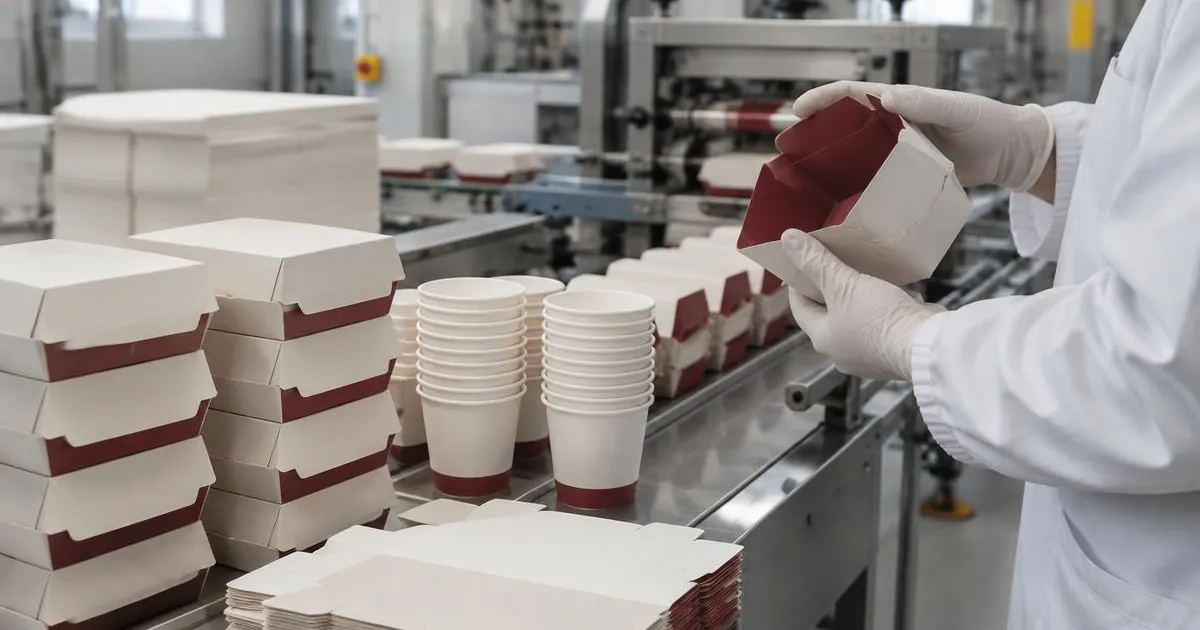
Food contact materials in the EU must not transfer anything into food that could harm health or change its taste, smell or composition. For printed food packaging that means three layers of rules: the framework regulation that covers every material, good manufacturing practice (GMP) for how packaging is made and printed, and specific rules for certain materials such as plastics. This guide explains what applies to boxes, cups, bags and wraps, and what buyers should ask a packaging supplier.
This article is general information, not legal advice.
Which rules apply to food contact materials in the EU?
The European Commission's overview of EU legislation on food contact materials starts with Regulation (EC) No 1935/2004, the framework regulation. It sets the principles of safety and inertness: materials must not release their constituents into food at levels that endanger health, and must not change the food's composition, taste or odour in an unacceptable way. The framework also requires labelling with the intended use or the appropriate symbol, compliance documentation and traceability.
Good manufacturing practice
Regulation (EC) No 2023/2006 on GMP applies across the manufacturing chain. The Commission summarises it as controlled production with suitable premises, staff who know the critical stages, documented quality assurance and quality control, and careful selection of starting materials.
Specific measures for some materials
Some food contact materials have their own EU rules. Plastics are covered by Regulation (EU) No 10/2011, with a Union list of permitted substances, migration limits and a declaration of compliance. Recycled plastics, ceramics, regenerated cellulose film and active and intelligent materials have specific measures too. Paper, board and printing inks are not on that list, so for them the framework, GMP and national rules apply.
How are printing inks on food contact materials regulated?
Most printed food packaging is printed on the outside. The GMP regulation addresses this directly in its annex: printing inks applied to the non-food-contact side must be formulated and applied so that substances from the printed surface are not transferred to the food-contact side. The recitals name the two routes that matter, set-off and transfer through the substrate. Set-off happens when printed sheets or reels are stacked or wound and the print touches the inside of the next layer.
The same regulation requires documentation on specifications, formulae and processing, which must be made available to the authorities on request. A printer who supplies food packaging should be able to show how it controls inks, drying and stacking.
Germany's printing ink rules from 2027
Because there is no EU measure for inks, Germany has created its own. Law firm GvW explains that the German ink ordinance applies from 1 January 2027 as part of the Federal Food Commodities Ordinance. Only substances listed in its Annex 14 may be used in inks for food packaging, with a general migration limit of 60 mg/kg of food where no specific limit is set. Printed articles placed on the market before that date may be sold until stocks run out.
According to Markem-Imaje's explainer, the rules apply to anyone supplying printed food contact materials to the German market, wherever the packaging is produced. If your packaging may end up in Germany, ask your printer now whether its inks are on the positive list.
What changed for bisphenol A in food contact materials?
Bisphenol A (BPA) is a good example of how specific rules tighten over time. Regulation (EU) 2024/3190 bans BPA and certain other bisphenols in food contact materials, and the EU's Access2Markets portal confirms the prohibition from 20 January 2025, with transition periods.
| Products | Date |
|---|---|
| Single and repeat use articles that met the old rules | Could be placed on the market until 20 July 2026 |
| Single use packaging with BPA varnish for fruit, vegetables and processed fish | Until 20 July 2028 |
| Repeat use professional food production equipment | First placing on the market until 20 January 2028 |
| Repeat use articles placed on the market under the old rules | May remain on the market until 20 January 2029 at the latest |
The general transition for single and repeat use articles ended on 20 July 2026, so coated cans, lids and reusable containers bought today should come with up-to-date paperwork.
What documents should a food contact packaging supplier provide?
The Finnish Food Authority explains how declarations and supporting documents work in practice. Every operator in the chain gives a declaration of compliance to the next operator, except at retail, and evidence of compliance must be available to the authorities at each stage. For plastics, the content of the declaration is set by law. For other materials, the plastics declaration can be used as a model, and the authority points to guidance from the Council of Europe's EDQM for materials without harmonised rules. It also recommends updating declarations when legislation or composition changes, and at least every three years.
Questions to include in your request
- Which food types, temperatures and contact times is the packaging suitable for?
- Can you provide a declaration of compliance for the finished, printed item, not only for the board or film?
- Which inks and coatings are used, and are they suitable for food packaging, including the German positive list if relevant?
- How do you prevent set-off in stacking and storage?
- Do you work to a documented GMP or hygiene system?
- Do any plastic layers, linings or coatings contain bisphenols?
Food contact materials, sustainability and the PPWR
Food safety rules sit next to packaging waste rules. When you change to a new paper-based or recycled material to meet recyclability goals, check the food contact side at the same time. Our articles on the EU Packaging and Packaging Waste Regulation and on what to ask suppliers about sustainable packaging cover the environmental questions.
On Flobid you can send one request for printed food packaging to matching suppliers and ask each of them to attach a declaration of compliance with the quote. Start a request for food packaging and describe the food, the temperature and where the packaging will be sold.
Sources
- Legislation: Food contact materials, European Commission
- Commission Regulation (EC) No 2023/2006 on good manufacturing practice for materials and articles intended to come into contact with food, EUR-Lex (2006)
- Declarations and documents demonstrating safety and regulatory compliance, Finnish Food Authority
- EU prohibition on the use and trade of Bisphenol A from 20 January 2025, European Commission Access2Markets (2025)
- Die Druckfarbenregelung (German Ink Ordinance (GIO)) gilt ab Januar 2027, GvW Graf von Westphalen (2026)
- German Printing Ink Ordinance (GIO) Explained: What Food Packaging Producers Need to Know, Markem-Imaje (2026)
Preguntas frecuentes
Is there an EU regulation for paper and board food packaging?
There is no EU specific measure for paper and board. The framework Regulation 1935/2004, the GMP Regulation 2023/2006 and national rules apply.
Can food packaging be printed on the outside with normal inks?
Inks on the non-food-contact side must be formulated and applied so that substances are not transferred to the food-contact side, for example by set-off. Ask the printer to confirm the inks are suitable for food packaging.
When do the German printing ink rules apply?
According to GvW, the German rules on printing inks for food packaging apply from 1 January 2027, with a sell-off period for articles placed on the market before then.