
EU Ecolabel for Printed Paper, Stationery and Paper Carrier Bags
Which printed products, stationery and paper bags can carry the EU Ecolabel, what the criteria demand from printers and how to verify a licence.
5 min läsning
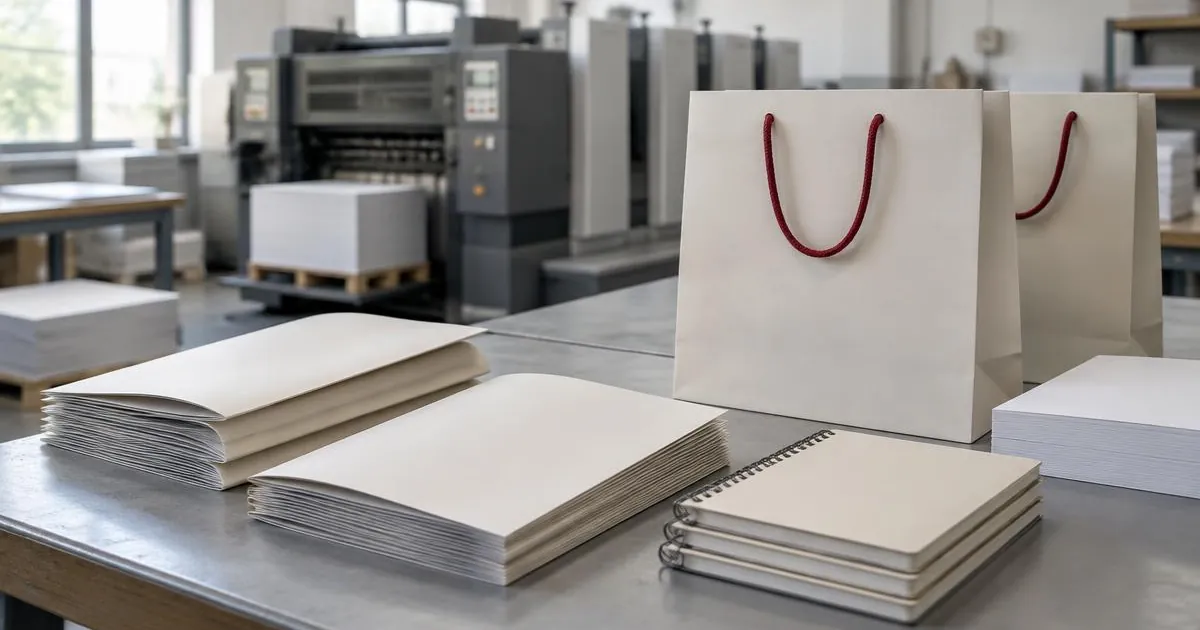
The EU Ecolabel for printed paper covers brochures, catalogues, books, envelopes, stationery such as notebooks and files, and paper carrier bags. A product with the label has been checked against criteria for the paper used, the chemicals in inks and adhesives, recyclability, emissions, waste and energy at the printing or converting site. This guide explains what the criteria require, which products qualify and how to check a supplier's licence.
What is the EU Ecolabel?
The EU Ecolabel is a voluntary environmental labelling scheme set up under Regulation (EC) No 66/2010. Products qualify when they have a lower environmental impact than others in the same group, assessed over the whole life cycle. Each EU country designates competent bodies that run the scheme, check compliance and handle complaints. Applicants sign a contract on the use of the label and pay application and annual fees.
Criteria are set per product group, and for printed and converted paper products, the current criteria are laid down in Commission Decision (EU) 2020/1803.
Which products can carry the EU Ecolabel for printed paper?
The product group covers three families, and the scope article sets minimum paper shares by weight:
- Printed paper products: generally at least 90% paper. Books, catalogues, booklets and forms need at least 80%.
- Envelopes: at least 90% paper.
- Paper carrier bags and wrapping paper: 100% paper based.
- Stationery paper, including filing products: at least 70% paper. Ring binders, exercise books, notebooks, diaries and lever arch files may contain up to 13% plastic.
What is excluded?
The decision excludes packaging and labels (except paper carrier bags and wrapping paper), corrugated board, food contact materials, tissue products, fragranced products and anything containing PVC. That means a printed shipping box or a folding carton cannot carry the label under this product group, even if the board itself is certified.
What do the EU Ecolabel criteria for printed paper require?
The full text of the decision sets ten criteria: substrate, restricted substances, recyclability, emissions, waste, energy use, training, fitness for use, information on the product and information on the label. The criteria buyers should understand are described below.
Substrate: the paper itself must be ecolabelled
All paper and paperboard in the final product must hold the EU Ecolabel for graphic paper under Decision (EU) 2019/70. The printer must provide certificates for each substrate. In practice this narrows the paper grades a printer can use for an ecolabelled job, which can affect price and availability.
Restricted substances
Inputs may not contain substances of very high concern above 0.10% by weight, and hazardous substances classified under CLP are capped at the same level with limited exceptions. Biocides are largely banned, and inks, toners, varnishes and cleaning agents face specific restrictions.
Recyclability
Printed products must reach a deinkability score of at least 51 on the European Paper Recycling Council scorecard. Adhesives must score at least 71 on the adhesive removal scorecard, unless they are water based. Lamination is restricted and double lamination is not allowed, which matters if your design calls for a laminated cover.
Emissions, waste and energy
The site must meet limits on volatile organic compounds that depend on the printing process, for example heatset web offset, sheetfed offset or digital. There are also requirements on waste handling, energy use and staff training.
How long are the EU Ecolabel printed paper criteria valid?
The criteria are valid until 31 December 2028. A 2025 assessment by the Commission's Joint Research Centre concluded that the criteria are still up to date and recommended keeping the decision as it is until that date, with a later revision linked to future ecodesign rules. Licences are tied to the criteria version, so ask suppliers how they plan for the next revision when you sign multi-year agreements.
How to check a supplier's EU Ecolabel licence
Use the official product catalogue: the Commission's EU Ecolabel Product Catalogue lists licensed products and services. According to the Commission, it holds more than 100,000 products from over 3,000 companies, and you can filter by product group or country or search for a licence number, product or company.
- Ask the supplier for the licence number and the product group it covers.
- Search the catalogue and check that the company name and product group match.
- Confirm that the specific product you are ordering is covered, not just another item from the same supplier.
- Agree how the label will be printed on the product, since the criteria include rules on information shown with the label.
Designing a print job that can meet the criteria
Many choices that block an ecolabel are made at the design stage, long before the order reaches the printer. If you want ecolabelled print, involve the supplier early and keep these points in mind.
- Paper choice: pick a paper grade the printer can source with the graphic paper ecolabel. Ask for two or three alternatives rather than insisting on one specific brand.
- Finishing: avoid double lamination, and ask whether a varnish or a single-sided coating can give the look you want.
- Glues and bindings: check that adhesives for binding or bag handles meet the removability requirement, or use water based alternatives.
- Non-paper parts: for notebooks and files, keep plastic and metal parts within the limits for the product type.
- Inserts: covers and printed parts count as part of the product, but loose inserts such as flyers and removable stickers do not, so ask how the supplier treats them in the application.
Ask for the ecolabel requirement in the first request rather than after the quote, because it can change the paper, the finishing and the price.
EU Ecolabel, FSC or PEFC: which should you ask for?
The EU Ecolabel and fibre certification answer different questions. FSC and PEFC tell you where the fibre came from, while the EU Ecolabel also covers chemicals, recyclability and the printing process. For a brochure or notebook where recyclability and inks matter, the ecolabel is the broader claim. For packaging, which this product group excludes, fibre certification is usually the relevant proof. Our guide on FSC vs PEFC explains the fibre labels.
Requesting ecolabelled print on Flobid
If you need ecolabelled brochures and catalogues, notebooks or paper carrier bags, state "EU Ecolabel, licence number on quote" in your request. Suppliers who hold a licence can say so, and you can check the number in the catalogue before you order.
Sources
- Ecolabel, EUR-Lex summaries of EU legislation
- Commission Decision (EU) 2020/1803 establishing the EU Ecolabel criteria for printed paper, stationery paper, and paper carrier bag products, EUR-Lex (2020)
- Commission Decision (EU) 2020/1803 (full text), legislation.gov.uk
- Assessment of the EU Ecolabel criteria for printed paper, stationery paper, and paper carrier bag products, European Commission Joint Research Centre (2025)
- One Label. More than 100,000 greener products. One Catalogue., European Commission Transition Pathways (2025)
- EU Ecolabel Product Catalogue (ECAT), European Commission
Vanliga frågor
Can a folding carton carry the EU Ecolabel for printed paper?
No. The printed paper product group excludes packaging and labels, except paper carrier bags and wrapping paper, and also excludes corrugated board.
Until when are the EU Ecolabel criteria for printed paper valid?
Commission Decision (EU) 2020/1803 is valid until 31 December 2028. A 2025 JRC assessment recommended keeping it unchanged until then.
How do I check an EU Ecolabel licence?
Search the licence number, product or company in the EU Ecolabel Product Catalogue (ECAT) and check that the product group matches what you are buying.