
Printing Industry Trends 2026: What Buyers Need to Know
Five sourced printing industry trends for 2026, from consolidation and digital packaging print to automation and PPWR, and what each one means when you buy print.
5 min czytania
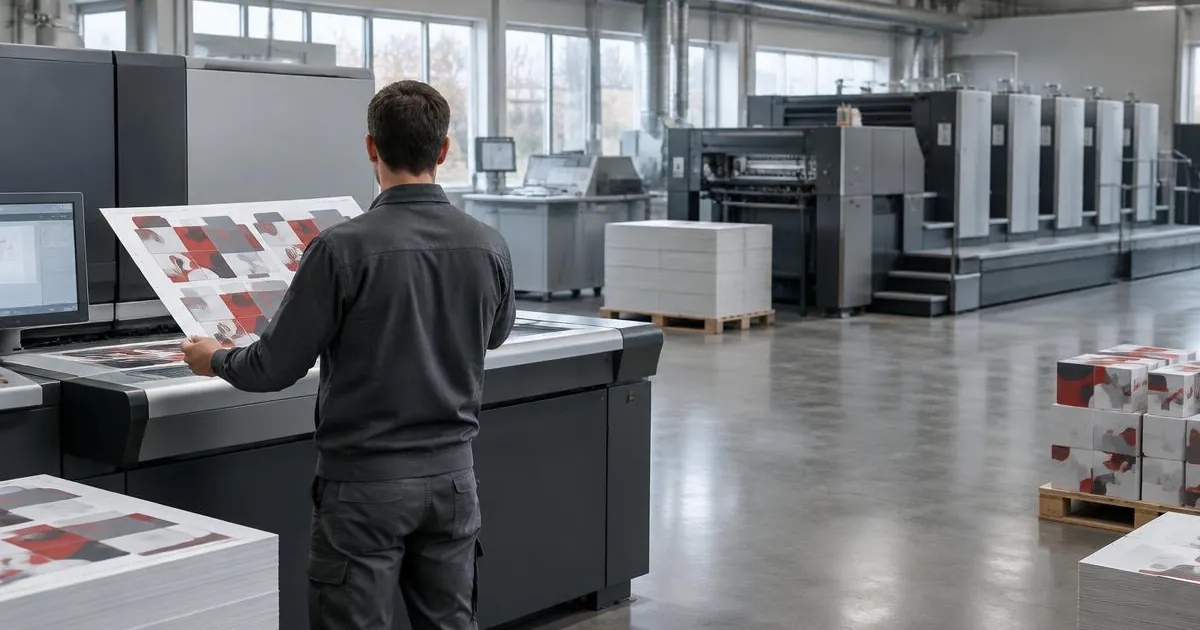
The main printing industry trends in 2026 are slow overall market growth, a steady shift of value towards packaging and labels, faster growth in digital printing, more automation and new EU packaging rules. At the same time, the number of print companies and employees worldwide keeps falling, so buyers are dealing with fewer but more specialised suppliers.
Below, each trend is backed by a published source, followed by what it means when you buy print or packaging.
How big is the print market in 2026?
Research firm Smithers puts the global print market at USD 868 billion in 2025 and expects it to reach about USD 969.7 billion by 2030, a compound annual growth rate of 2.2 percent, as reported by PrintWeek India. That is modest growth, and it hides large differences between segments: some traditional print categories shrink while packaging grows.
For buyers, a slow growing market with rising costs often means printers compete hard on price for standard work, while capacity for specialised jobs can still be tight.
Printing industry trends 2026: the five that matter for buyers
1. Fewer print companies, more consolidation
Smithers reports in its 2026 analysis of printer demographics that the number of print establishments fell from 384,102 in 2019 to 353,707 in 2024, a drop of 7.9 percent. Employment fell 12.7 percent, from 3.9 million to 3.4 million, over the same period. Packaging and labels are excluded from those numbers, and Smithers notes they continue to grow. It expects traditional print categories to keep declining to 2031, but more slowly.
In practice, this means your existing supplier may merge, change ownership or drop a product line. Keeping two or three qualified suppliers per category is a sensible safeguard.
2. Digital printing for packaging keeps growing
Smithers values the digital packaging and label print market at USD 22.0 billion in 2025, or 4.1 percent of all printed packaging, and forecasts USD 36.9 billion and 5.8 percent by 2030, according to the report summary. Digital is already common in labels, and inkjet is gaining ground on large presses for cartons, corrugated and flexible packaging.
Digital makes short runs, versions and fast changes cheaper, which matters for seasonal packaging and test launches. Our article on digital printing on corrugated packaging looks at this in more detail.
3. Automation as a growth driver
FESPA's 2026 Print Census findings describe automation as increasingly central to efficiency, lower costs and new growth, and as a practical priority for businesses of all sizes. Smithers also lists automation among its key trends, along with sustainability, recruitment challenges and cautious adoption of AI.
Automation is the industry's answer to labour shortages and price pressure. For buyers it can mean faster turnaround and fewer errors, but it rewards clean files and clear specifications.
4. Regulation pushes packaging design
The EU Packaging and Packaging Waste Regulation (EU) 2025/40 generally applies from 12 August 2026, according to the European Circular Economy Stakeholder Platform. All packaging must be recyclable, with recyclability performance grades from 2030. At interpack 2026, the organiser named PPWR a key focus in its closing report, alongside smart manufacturing and new materials.
5. Systems instead of single machines
The organiser of drupa 2028 highlights end-to-end solutions, automation, robotics, AI, materials and the circular economy in its release opening exhibitor registration. The direction is clear: printers are buying connected workflows rather than individual presses.
What do these printing industry trends mean for purchasing?
Trends only matter if they change how you buy. Here is how they translate into everyday decisions.
| Trend | What to do as a buyer |
|---|---|
| Fewer, larger print companies | Qualify a second supplier for important items |
| Growth in digital packaging print | Ask for digital quotes on short runs and versions |
| More automation | Send print-ready files and complete specifications |
| PPWR and recyclability | Review materials, coatings and mixed constructions |
| Connected workflows | Ask about online proofing, order tracking and reorders |
Compare offset and digital on every job
The break-even point between offset and digital moves as technology improves. Ask suppliers to quote both where they can, and see our guide to offset vs digital printing for the main differences.
Ask how sustainability claims are backed up
Sustainability appears in almost every list of printing industry trends, including the Smithers analysis. Claims are easy to make and harder to check. Ask which certificate applies to the material you are buying, whether it covers the supplier's site, and what the supplier can document about inks, coatings and waste. If you need FSC or PEFC material, write that into the request so every quote is based on it.
Expect AI in small steps
Smithers describes AI adoption among printers as cautious. Where it appears first is usually behind the scenes: estimating, scheduling and prepress checks. You may notice faster quotes and file checks before you notice anything on the printed product.
Plan lead times realistically
Fewer suppliers and tighter staffing can stretch lead times in peak periods. Give suppliers your yearly volume forecast where possible, and order seasonal items early. A short call before peak season to agree slots costs little and often saves a rush fee later.
Which printing segments are growing and which are shrinking?
The sources above point in the same direction. Packaging and labels continue to grow, while traditional commercial and publication print shrinks in number of companies and staff. Digital printing grows faster than analogue printing within packaging, from a small base. Overall market value still rises slightly, partly because of the shift towards higher value packaging work.
None of this means offset or flexo are disappearing. Long runs remain cheaper on analogue presses, and most printed packaging is still produced that way. What changes is the share of work that is short, versioned or fast, and that is where digital and automated workflows gain.
Getting comparable quotes in a changing market
When suppliers differ in technology, comparing quotes gets harder. Describe the job once, with quantity, material, print, finishing and delivery, and send the same request for quotation to several suppliers. Our printing buyer resource pack includes checklists for a complete specification.
Sources
- Global print market projected to surpass USD 969-billion by 2030, PrintWeek India
- Global Print Establishments and Employment Continue to Decline, Smithers (2026)
- The Future of Digital Print for Packaging to 2030, Smithers (2025)
- FESPA Print Census Reveals Automation as Key Driver of Industry Growth, Texintel (2026)
- The EU Packaging and Packaging Waste Regulation: when will it come into effect and what does it cover?, European Circular Economy Stakeholder Platform (2026)
- interpack 2026 sends a global signal for the industry, Messe Düsseldorf (2026)
- Go-ahead for drupa 2028: exhibitor registration now open, Messe Düsseldorf
Często zadawane pytania
Is the printing industry growing in 2026?
Slowly, according to Smithers, which values the global print market at USD 868 billion in 2025 and expects about USD 969.7 billion by 2030, a 2.2 percent annual growth rate.
Which part of printing is growing fastest?
Packaging and labels keep growing, and digital printing for packaging grows fastest, from USD 22.0 billion in 2025 to a forecast USD 36.9 billion in 2030 according to Smithers.
Why are there fewer printing companies?
Smithers reports print establishments fell 7.9 percent between 2019 and 2024, excluding packaging and labels, as traditional print categories declined.