
interpack 2026: Packaging Highlights and What They Mean for Buyers
interpack 2026 in Düsseldorf was the largest edition yet by exhibitors. Here is what the organiser reported on PPWR, materials and smart manufacturing, and what it means for buyers.
Lukuaika 5 min
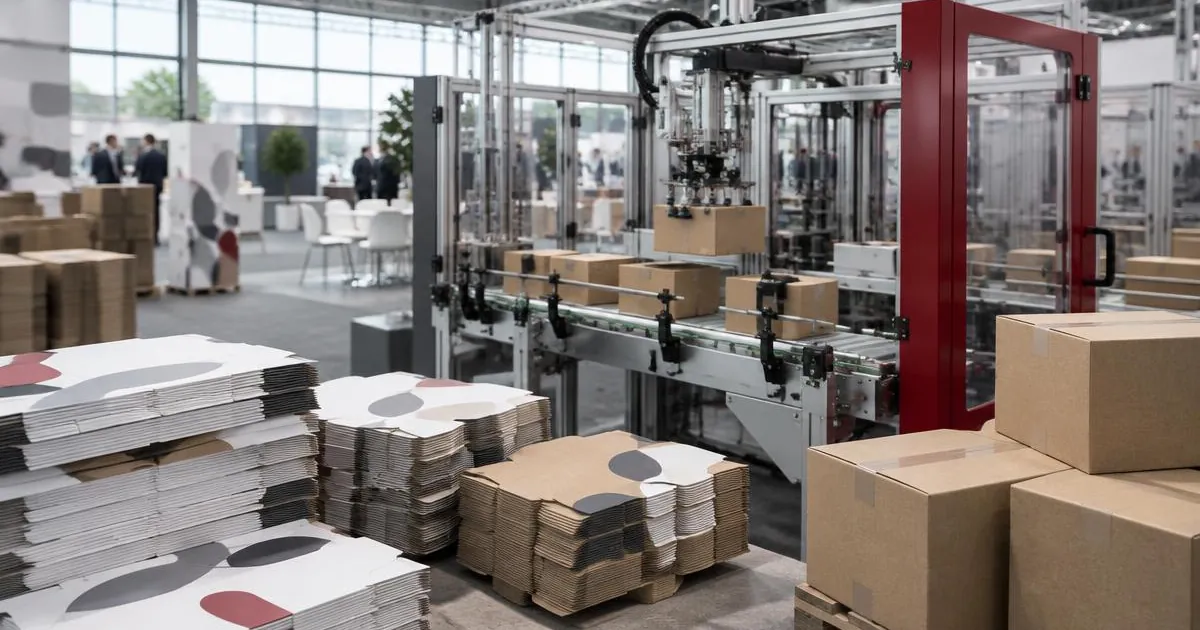
interpack 2026 ran from 7 to 13 May 2026 in Düsseldorf and, by exhibitor count, was the largest edition in the fair's history. The headline themes were the EU Packaging and Packaging Waste Regulation (PPWR), smart manufacturing and new packaging materials, all presented as parts of one connected system rather than separate topics.
Below is a factual summary of what the organiser reported and what it means for companies that buy printed and converted packaging.
interpack 2026 in brief: dates, scale and visitors
Messe Düsseldorf's closing press release gives the key facts:
- Dates: 7 to 13 May 2026, Düsseldorf, Germany
- Exhibitors: 2,804 from 65 countries, the most in interpack's history
- Supplier fair: the parallel components fair added about 100 more companies
- Visitors: from 161 countries, 75 percent from outside Germany and 28 percent from outside Europe
- Strong sectors: food and pharmaceuticals
The release does not give a total visitor number, so we do not quote one. It says interpack returns in 2029, with the exact dates to be announced.
What were the interpack 2026 hot topics?
Before the fair, the organiser defined three Hot Topics in its announcement that the show was fully booked, and these topics framed much of what exhibitors presented.
Smart manufacturing
This covered more intelligent, sustainable and economical production: AI supported systems, robotics, automation, intelligent control, data driven value and resource efficiency. The closing release describes automation, data based applications and flexible plant concepts shown as practical applications rather than distant ideas.
Innovative materials
Here the focus was on advanced plastics, fibre based materials, intelligent coatings, monomaterials, bio based solutions and design for recycling. According to the organiser, around 1,000 exhibitors in the packaging section related to this topic.
Future skills
The third topic looked at qualification, young talent and the digital know how needed to run connected, data driven production lines.
Special areas and side programme
Alongside the halls, the closing release lists the interpack Spotlight Forum, SAVE FOOD Expert Talks, Women in Packaging, a Start-up Zone and a Young Talents Day. The SAVE FOOD talks are a reminder that packaging is judged not only on material use but also on how well it prevents product waste, which is a useful balance to keep in mind when you simplify a pack.
How the halls were organised at interpack 2026
interpack is laid out by the industries that buy packaging, not only by product type. The organiser grouped exhibitors around eight visitor target groups: food, beverages, confectionery, baked goods, pharmaceuticals, cosmetics, non-food and industrial goods. Packaging materials and goods, labelling and marking, packaging material production and integrated packaging printing each had their own halls, and the components supplier fair had two halls of its own for the first time.
That structure tells you something about how the industry sells. Machinery is presented as a solution for a sector, while materials and printed packaging sit in shared halls that serve all sectors. For a buyer it means the most relevant conversations about board, film and print are often found away from the big machinery stands.
Why PPWR was the defining theme of interpack 2026
The closing release names the PPWR as a key focus of the fair. The regulation, Regulation (EU) 2025/40, entered into force on 11 February 2025 and generally applies from 12 August 2026, according to the European Circular Economy Stakeholder Platform. It requires all packaging to be recyclable, with recyclability performance grades from 2030 and stricter obligations later.
Exhibitor statements collected by the organiser in its preview of exhibitor focus topics reflect this. One machinery group said it would show how it helps customers implement the PPWR while balancing product safety, traceability and recyclability. A board maker pointed to demand for fossil free, recyclable materials driven by regulation and changing consumer preferences, and a packaging group said regulatory readiness has become a decisive factor in packaging decisions.
For a detailed look at the rules themselves, see our guide to the EU Packaging Regulation PPWR.
Packaging materials and printing: what buyers should take from interpack 2026
Most visitors to interpack look at filling and packing lines, but the materials and converting halls matter just as much to purchasing teams. The organiser grouped packaging materials, labelling and marking, packaging material production and integrated packaging printing in their own halls.
Expect more questions about recyclability
With recyclability now a legal baseline, suppliers are likely to ask about the whole pack: board grade, coatings, inks, labels and adhesives. Have this information ready, and ask suppliers which parts of a design could make recycling harder.
Monomaterials and fibre based options
The materials topic pointed to monomaterial structures and fibre based alternatives. If you are reviewing a mixed material pack, ask suppliers for a like for like quote on a simpler construction, and request test samples before you change a running product.
Lighter board and smaller packs
One exhibitor highlighted lightweight cartonboard with a reduced carbon footprint. Lighter grades and tighter pack sizes can cut material and freight, but always confirm that the pack still protects the product in your supply chain.
Automation on the supplier side
Smart manufacturing is mostly an investment for converters and brand owners with their own lines. For buyers it shows up indirectly: suppliers with more automated, data driven production may offer better traceability, more consistent quality and faster changeovers. It is reasonable to ask a supplier how they track batches and how quickly they can switch between print versions.
A practical checklist after interpack 2026
If the fair prompted a packaging review, these steps keep it concrete:
- List your current packaging items with material, size, print and annual volume.
- Mark which items mix materials, use special coatings or have a lot of empty space.
- Ask suppliers which changes would improve recyclability without hurting protection.
- Request declarations for materials and any certificates you need, such as FSC or PEFC.
- Compare quotes on the same specification so that price differences are real.
Our list of questions to ask about sustainable packaging helps with step three.
Getting quotes on new packaging
Once you know what you want to change, describe the item once and send it to several converters at the same time. A request for printed corrugated packaging on Flobid goes to suppliers in that category who deliver to your country, and you can ask for certificates in the same request. You can also browse the wider packaging category to see which supplier types are listed.
Sources
- interpack 2026 sends a global signal for the industry, Messe Düsseldorf (2026)
- interpack 2026 is fully booked, the Hot Topics have been defined, Messe Düsseldorf
- interpack 2026: Focus of exhibitors at this edition, Messe Düsseldorf (2026)
- The EU Packaging and Packaging Waste Regulation: when will it come into effect and what does it cover?, European Circular Economy Stakeholder Platform (2026)
Usein kysytyt kysymykset
When was interpack 2026?
interpack 2026 took place from 7 to 13 May 2026 at the exhibition centre in Düsseldorf, Germany.
How many exhibitors were at interpack 2026?
The organiser reported 2,804 exhibitors from 65 countries, plus about 100 companies at the parallel components fair.
What were the main themes at interpack 2026?
The organiser named the EU Packaging and Packaging Waste Regulation, smart manufacturing, innovative materials and future skills as the main themes.
Aiheeseen liittyvät sivut
- Etsi toimittajiaHae eurooppalaisia toimittajia kategorian ja maan mukaan.
- Maksuttomat pohjatTarjouspyyntöpohjat ja tarkistuslistat PDF- ja Word-muodossa.
- ToimittajilleTodellisia tarjouspyyntöjä, jotka vastaavat sitä, mitä valmistatte.
- BlogiOppaita hankinnasta, arvonlisäverosta, tullista ja tuotannosta.