

Digital Production Press Guide: Toner vs Inkjet Explained
Toner or inkjet: how each type of digital production press works, where each one fits, and what the difference means when you buy print or equipment.
5 min lesing
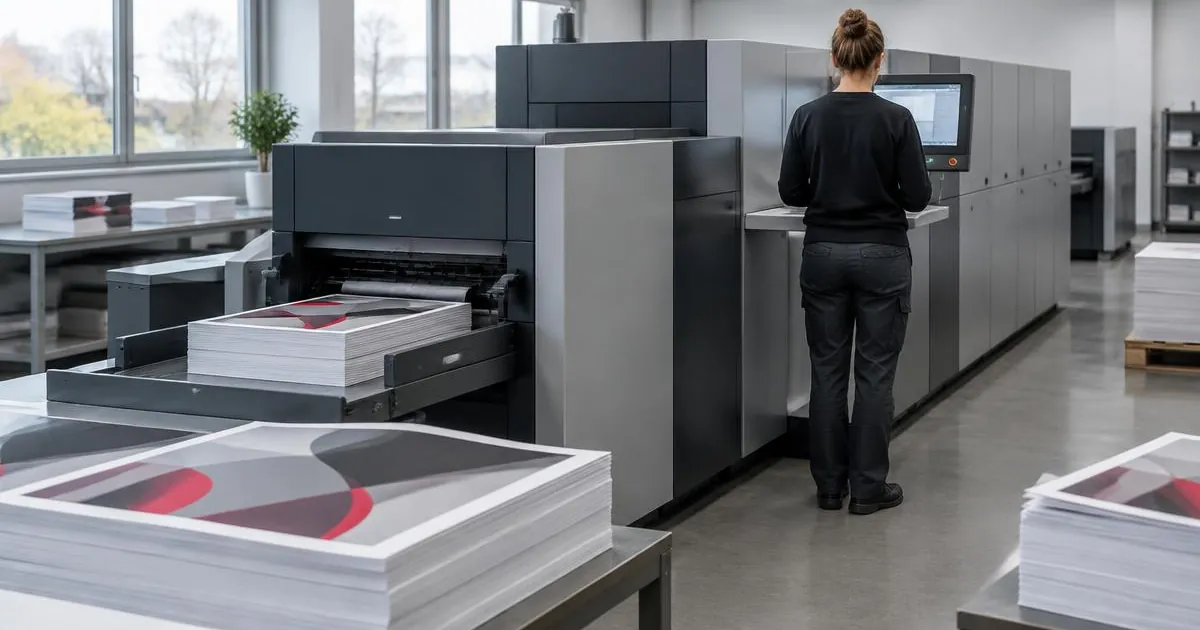
A digital production press prints directly from a digital file, without printing plates, at speeds and volumes meant for commercial work. There are two main technologies: toner presses, which build the image with electrostatic charges, and inkjet presses, which spray tiny drops of ink onto the paper. Toner is often cheaper to start with and handles varied stocks well, while inkjet tends to win on speed and cost per page at higher volumes.
This guide explains how each type works, where each fits, and what the difference means when you buy print or a machine.
What is a digital production press?
The term covers presses built for professional output, as opposed to office printers. They print variable data, short runs and personalised items economically because there is no plate making and very little setup. Digital production presses come in the following two formats:
- Cut-sheet: fed with individual sheets, common in commercial print shops and in-plant print rooms
- Continuous feed (roll-fed or web): printing on a roll of paper, used for high volume work such as transactional mail and books
Both toner and inkjet presses are available in cut-sheet format, and printers often run the two side by side. Continuous feed presses are typically chosen for the highest volumes.
How does a toner digital production press work?
Toner presses use electrophotography, and an open textbook on print production from the Graphic Communications Open Textbook Collective describes the principle: a laser or LED array writes the image onto a light sensitive drum, charged toner particles are attracted to the image areas, and the toner is then transferred to the paper and fixed.
Dry toner and liquid toner
Dry toner is a fine powder of resin, pigment and additives. According to the same textbook, conventional toner particles average roughly 6 to 10 microns, while chemically produced toner can be under 5 microns, which supports higher resolution. Liquid toner uses much smaller particles, 1 to 2 microns, suspended in imaging oil, and gives thin, even layers. Some substrates need a pretreatment for liquid toner to adhere.
Strengths and limits of toner
A technical comparison published on FINAT's website by a label press maker notes that toner sits on the surface of the substrate rather than penetrating it, and that some synthetic substrates need pretreatment. Toner presses are often charged per click, a fixed fee per print regardless of coverage, which makes heavy coverage work relatively economical. Temperature and humidity can affect the static charge, which can influence colour consistency.
How does an inkjet digital production press work?
Inkjet is a non-contact process in which software turns the artwork into dots, and nozzles in the print heads place droplets of ink on the substrate. Inks can be water-based or UV curable; UV inkjet is widely used for labels, where it is partly set by a pinning lamp and then fully cured.
Strengths and limits of inkjet
The FINAT article explains that, because inkjet does not touch the substrate, it can inherently run faster, and that lowering the resolution raises speed on most inkjet presses. Print head cleaning, capping and alignment can largely be automated with onboard tools, while cleaning and recalibrating a toner press usually takes longer and needs a skilled operator. Inkjet also tolerates changes in temperature and humidity well.
On cost, the same article notes that inkjet is often cheaper for average or low coverage work because ink use follows coverage. With water-based inkjet, the paper you print on matters a lot: some papers are made or treated for inkjet, and others may give weaker results, so test on your own stock.
Toner vs inkjet: side-by-side comparison
| Aspect | Toner (electrophotography) | Inkjet |
|---|---|---|
| Imaging | Electrostatic image on a drum, transferred and fused | Droplets jetted directly onto the substrate |
| Cost model | Often a click charge per print | Ink cost follows coverage |
| Heavy coverage | Click charge does not rise with coverage | Ink cost and drying rise with coverage |
| Light coverage, high volume | Less cost effective | Usually cheaper per page |
| Paper range | Wide, synthetic stocks may need pretreatment | Depends on ink; some papers need inkjet treatment or primer |
| Maintenance | Cleaning and recalibration need a skilled operator | Head cleaning and alignment largely automated |
These are general tendencies, and individual presses vary widely, so always test on your own paper and artwork.
Which technology suits which job?
Printers interviewed by Printing Impressions describe how they split work in practice. Several run both technologies side by side and route each job to the press that suits it. One uses toner for jobs under 500 pieces, especially when the paper changes between jobs, and inkjet for higher volumes where speed and cost per sheet matter. Another notes that toner click charges push larger jobs towards inkjet, and that customers accept toner, inkjet and offset output as equivalent for many jobs. A third points out that toner has a lower cost of entry, while high ink prices can be a drawback of inkjet, and that inkjet systems in its plant produce more than half of all pages even though they are a minority of machines.
Typical toner work
- Short runs of brochures, flyers and presentation material
- Jobs on mixed or special papers
- High coverage images and colour critical marketing work
Typical inkjet work
- High volume direct mail and transactional print
- Books and manuals printed on demand
- Longer runs where cost per page decides
What it means when you buy print
You rarely need to specify the technology yourself. Specify the result: paper, size, quantity, colour expectations and finishing, and let suppliers propose the process. Ask which press they plan to use and request a proof on the actual paper if colour matters. For the choice between digital and plates, see our guide to offset vs digital printing, and check your files against our print-ready PDF checklist.
Buying a press or finding a print supplier
If you are investing in equipment, compare offers on the same basis: expected monthly volume, paper range, coverage, service terms and consumable costs. On Flobid you can send a request for digital production presses to machine suppliers, or browse the machines and equipment category.
Sources
- Chapter 6. Imaging, Graphic Design and Print Production Fundamentals, Graphic Communications Open Textbook Collective (2015)
- How to Choose a Digital Printing Press: Comparing Inkjet vs Toner in Label Printing, FINAT member news (2024)
- Inkjet vs. Toner-Based Digital Printing Presses. Which Is Right for Your Business?, Printing Impressions (2023)
Ofte stilte spørsmål
What is the difference between toner and inkjet presses?
Toner presses build an electrostatic image on a drum and transfer charged toner to the paper. Inkjet presses spray droplets of ink directly onto the substrate without contact.
Is inkjet cheaper than toner?
Often for high volume, low coverage work, because ink use follows coverage. Toner presses with click charges can be more economical for heavy coverage and short runs.
Can a digital production press print on any paper?
No. Toner presses handle a wide range but some synthetic stocks need pretreatment, and inkjet results depend on the ink and on whether the paper is suited to inkjet.